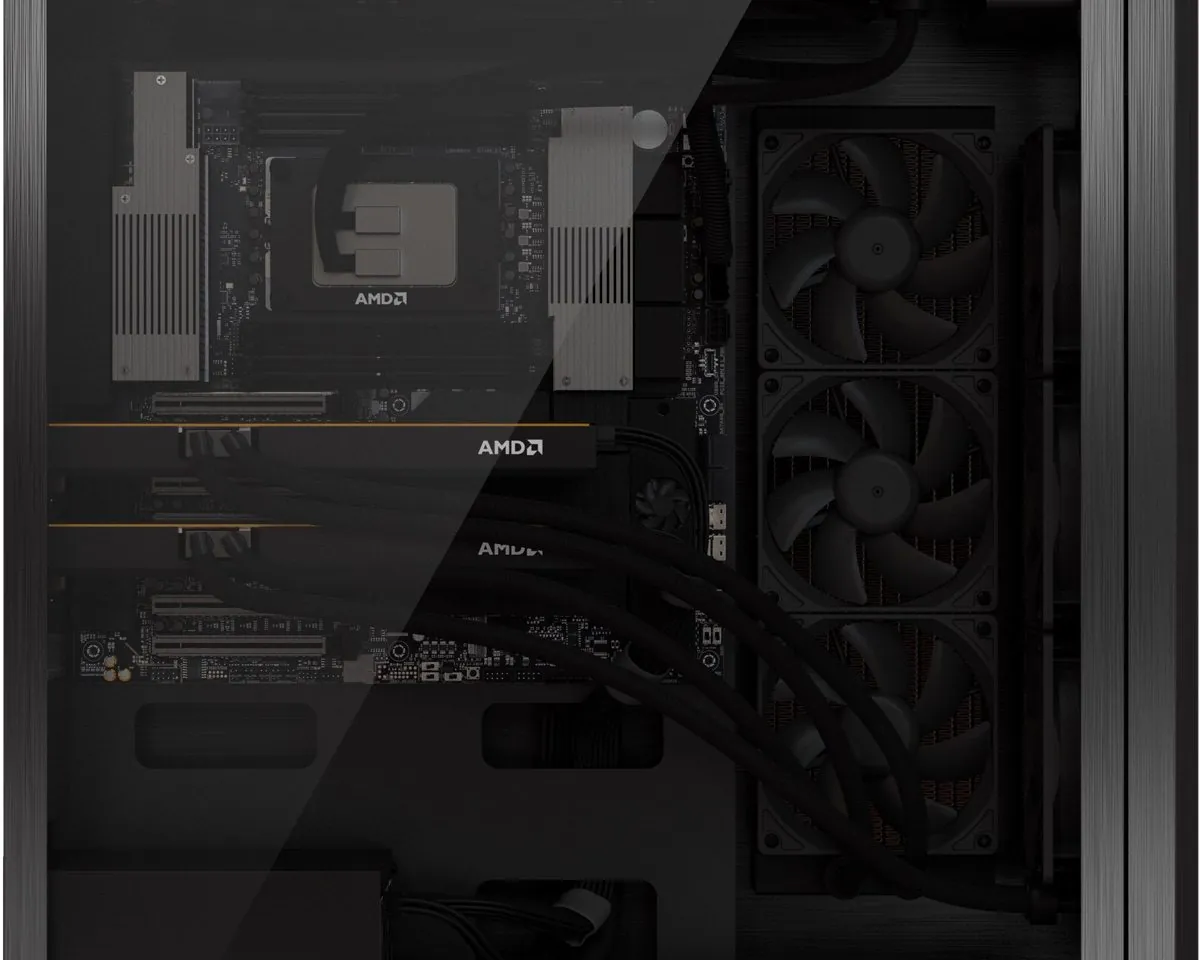
AMD used its IFA 2026 keynote to show the Threadripper Halo Station, a deskside workstation designed to run large AI models and agent workloads locally. The company introduced the prototype in its official IFA keynote video and official announcement post on September 4, positioning it as a way to move data-center-class memory capacity closer to individual developers and small teams.
The system is not a shipping product yet. AMD’s Threadripper Halo Station product page says it is coming in 2027 and identifies the machine as a prototype being shown for the first time at IFA. AMD has not published pricing or a retail launch configuration, so the useful story is the system design rather than a buying recommendation.
A workstation built around memory capacity
AMD lists a Ryzen Threadripper PRO 9995WX processor with 96 Zen 5 cores and 192 threads. The platform can be configured with up to 2TB of RDIMM system memory and up to four AMD Instinct-class HBM accelerators, giving the system as much as 576GB of HBM3e GPU memory. AMD’s published configuration notes that each accelerator contributes 144GB of HBM3e and up to 4TB/s of peak memory bandwidth.
With those parts combined, AMD quotes up to 2.6TB of total system memory and up to 16.4TB/s of total system memory bandwidth. The headline is capacity, not a claim that every workload will scale linearly. Large models often spend more time moving weights and key-value caches than performing arithmetic, which is why our report on memory bandwidth as an AI hardware bottleneck is useful context for reading the specification.
The product page also describes the system as liquid-cooled. That is a practical consequence of combining a workstation CPU with multiple high-memory accelerators in one chassis. AMD says the design is intended for training, fine-tuning, local inference, and intensive agentic workflows, but it does not publish independent performance measurements for the prototype.
Local AI without pretending it is a normal desktop
AMD is presenting the Halo Station as a personal AI workstation, but the configuration sits closer to a compact server than a conventional tower PC. Four accelerators with 576GB of HBM3e would provide room for very large models at lower precision, while the RDIMM pool can hold additional data or support workloads that do not fit entirely in accelerator memory. That arrangement could reduce dependence on shared cloud capacity, but it also brings server-class power, cooling, software, and system-integration questions.
This matters because local AI is not defined only by whether a model starts on a desktop. Memory size, software support, model format, and the path between CPU and accelerators determine whether a workload remains responsive. Our earlier coverage of the own-your-hardware case for local models made the same distinction from the user side: ownership is valuable when the machine can actually keep the needed workload local.
The Halo Station also expands the hardware choices beyond the smaller local AI systems now aimed at developers. Readers comparing accelerator roles can use our TPU versus GPU explainer for the broader picture. AMD’s prototype is not a new accelerator architecture announcement. It is a system-level attempt to make data-center memory and bandwidth available in a workstation form factor.
For now, the boundaries are clear. AMD has shown the concept, published a high-end configuration, and set a 2027 target. It has not announced price, final availability, OEM partners, or independent benchmarks. Those details will decide whether the Threadripper Halo Station becomes a practical tool for AI researchers and small teams or remains a showcase for how much local model capacity a deskside system can hold.