Snap is positioning its SPECS augmented-reality glasses as a hands-free work computer, announcing enterprise partnerships with Salesforce, Amazon Web Services, NVIDIA, Trifork and Hololight. In Snap’s September 16 enterprise announcement, the company describes field-service, remote-support and retail use cases built around information displayed in a worker’s view.
The announcement extends the hardware story Snap published when it introduced SPECS. The glasses are standalone rather than phone-tethered, and the company’s official product description lists a 51-degree field of view, 16 million colors and two frame sizes weighing 132 or 136 grams. Snap says SPECS are available to preorder for $2,195, with a $200 refundable deposit and fall shipping in the United States, United Kingdom and France.
Agents for work that does not happen at a desk
Snap says Salesforce is bringing Agentforce to SPECS so an employee can identify an object, create a case, surface company information and update a workflow without leaving the task. The example is deliberately practical: the value is not a floating demo but the ability to keep both hands available while information arrives in the field of view.
AWS is working with Snap to connect SPECS to Amazon Quick, which Snap describes as an AI assistant for work. The company’s retail example has an associate asking where a product is located, how many are in stock and what else is needed, with the response delivered through the glasses. Those are proposed workflows from the companies, not evidence that every retail or service deployment already supports them.
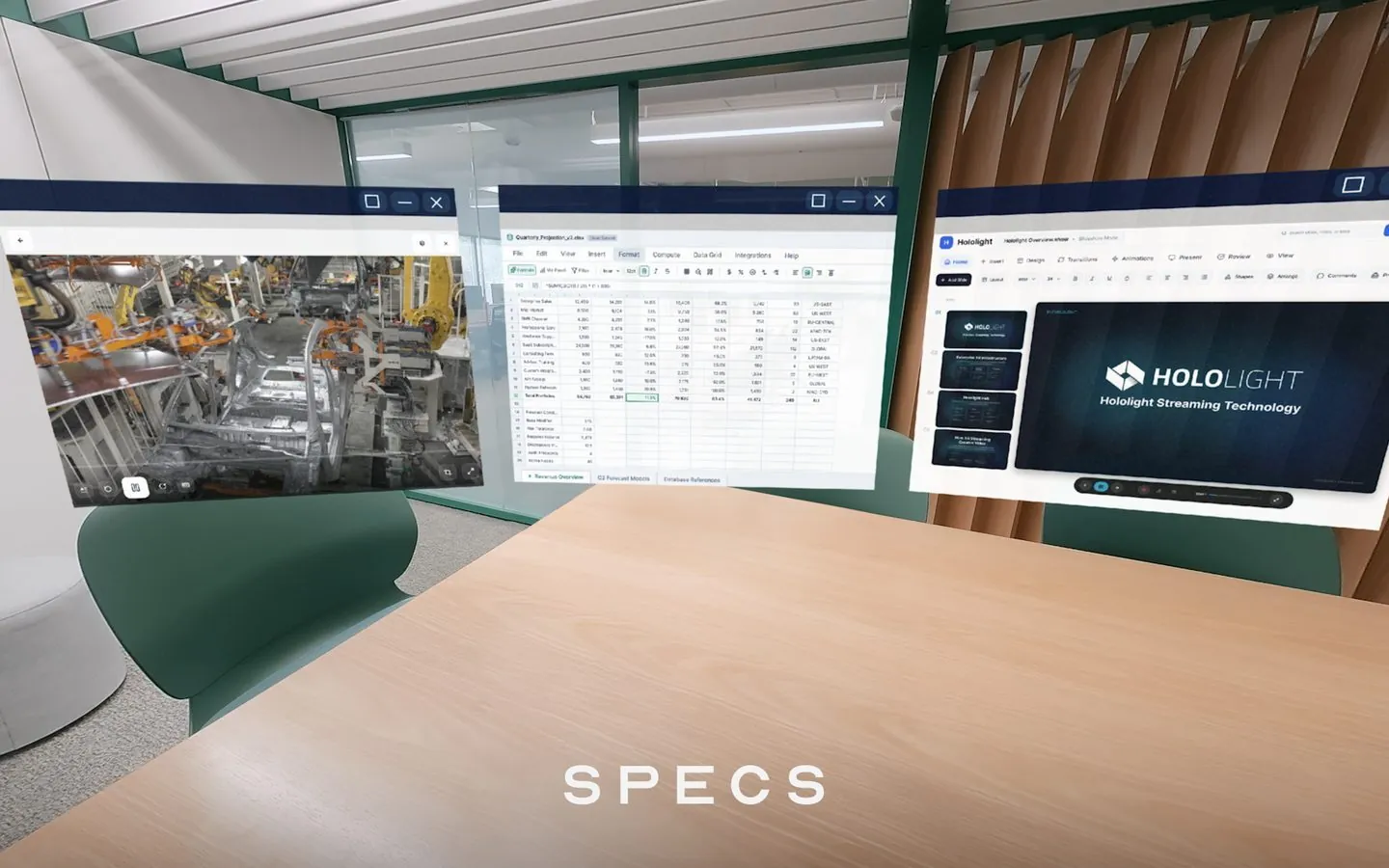
NVIDIA is working with Snap on agents built on the NVIDIA XR AI stack. Snap says those systems are intended to understand a worker’s surroundings, access relevant company data and provide guidance in real time. Trifork’s Tandem is described as a remote-support system in which an expert can see what a technician sees, identify components and add visual annotations to the technician’s view. Hololight is exploring SPECS as a spatial workstation for tools, documents and 3D models.
The hardware’s standalone design is important to that pitch. Snap’s product announcement says SPECS use a proprietary liquid-crystal-on-silicon display, redesigned waveguides and electrochromic lenses that switch from clear to tinted in 10 seconds. It also says the glasses are made from Swiss TR90 polymer and accept removable prescription inserts. These details describe the product as Snap presents it, not as an independent comfort or durability test.
The move connects to a broader shift already visible in AI hardware. Neon Control’s coverage of wearable AI research looks at agents working with sensor data, while our Agents API report covers the software side of systems that can use tools and act across services.
Enterprise adoption will depend on factors Snap’s announcement does not settle, including device management, privacy controls, connectivity, battery endurance under sustained use and the reliability of the visual guidance. The partnerships give SPECS a clearer workplace target than a generic AI-glasses pitch, but the product still has to prove that its display and agent software reduce friction instead of adding another layer to a worker’s attention.