Chinese AI developer Z.ai released GLM-5.3 on August 14, an open-weights model built on the same base as its GLM-5.2 predecessor. “Scaling post-training is all we did for GLM-5.3,” the company writes in its announcement, attributing every gain to training rather than architecture.
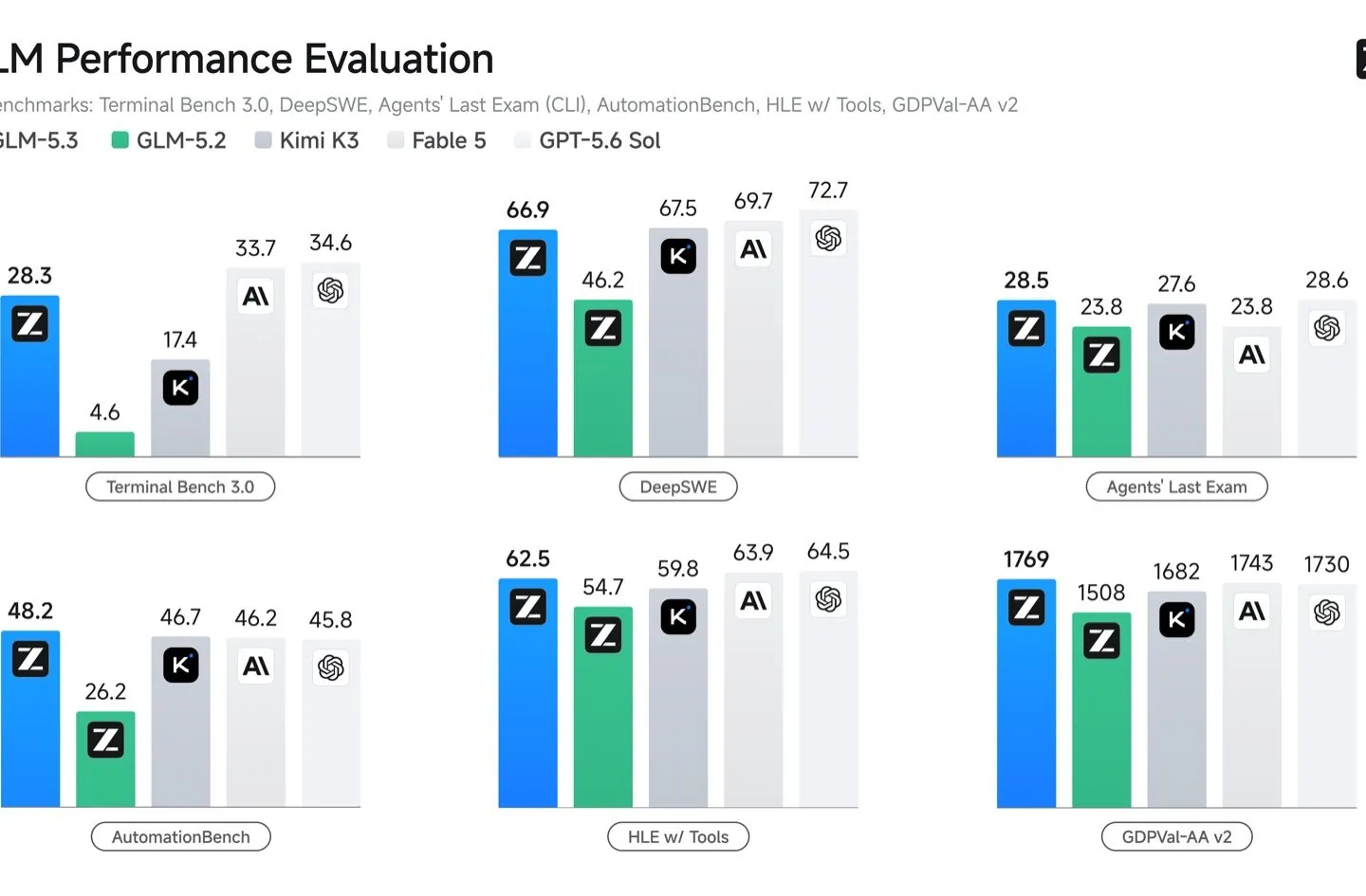
Z.ai says GLM-5.3 is its most capable open-weights model for coding, with a 50 percent improvement over GLM-5.2 on the company’s internal coding-agent benchmark, and the highest score of any open-source model on Terminal Bench 3.0, which measures command-line scripting. The model is available now in Z.ai’s coding plan, with API access coming soon and open weights expected on Hugging Face in about two weeks.
Coding and agentic gains
The release lands days after DeepSeek shipped its official V4 Pro with DSpark decoding, and the two models appear side by side in Z.ai’s benchmark charts along with Kimi K3, Qwen3.8-Max, Anthropic’s Opus 4.8 and Fable 5, and GPT-5.6 Sol. Independent analysis from Interconnects AI, which tracks open-weights model development, says GLM-5.3 surpasses Moonshot’s Kimi K3 on many benchmarks and matches or beats frontier US models on some, despite running roughly a third of Kimi K3’s parameter count. Like GLM-5.2, the new model uses a mixture-of-experts design reported at 753 billion parameters with a 1 million token context window.
Z.ai’s post-training push ran in sandboxes modeled on real developer workstations, with some exercises spanning days of work for an experienced engineer. The company says that pushes the model toward owning substantial work end to end, rather than relying on a user to decompose each problem and supervise every step, and that its internal evaluations showed the training method also lifted long-horizon task performance. The announcement’s comparison chart covers six benchmarks, including Terminal Bench 3.0, DeepSWE, Agents’ Last Exam, AutomationBench, HLE with Tools, and GDPVal-AA v2.
An emerging cyber capability
The most striking results are in security research. Z.ai reports GLM-5.3 is state of the art on CyberGym, a benchmark for vulnerability discovery, and says it more than doubles GLM-5.2 on exploitation benchmarks as gains scale up the exploitation chain. SiliconANGLE, which covered the release, notes the model outperformed Anthropic’s Claude Mythos 5 on CyberGym while trailing it on two other cybersecurity benchmarks.
The company says the model has tracked 2,436 findings across 269 software projects, with 2,383 still under embargo and 53 publicly disclosed; the tracked flaws include 107 rated critical, 990 rated high, and 1,286 rated medium, and findings span 45 years of impact, with the oldest dating to code written in 1981. Z.ai maintains a public security disclosure ledger for the findings it makes public.
For self-hosted deployments, the open-weights release matters as much as the scores: like the recent Muse Glimmer release from Meta, it keeps feeding the case that capable agentic models can run on hardware you control, a topic we explored in our local AI hardware explainer. The Hugging Face release in about two weeks will decide how quickly GLM-5.3 spreads beyond Z.ai’s own coding plan and API.