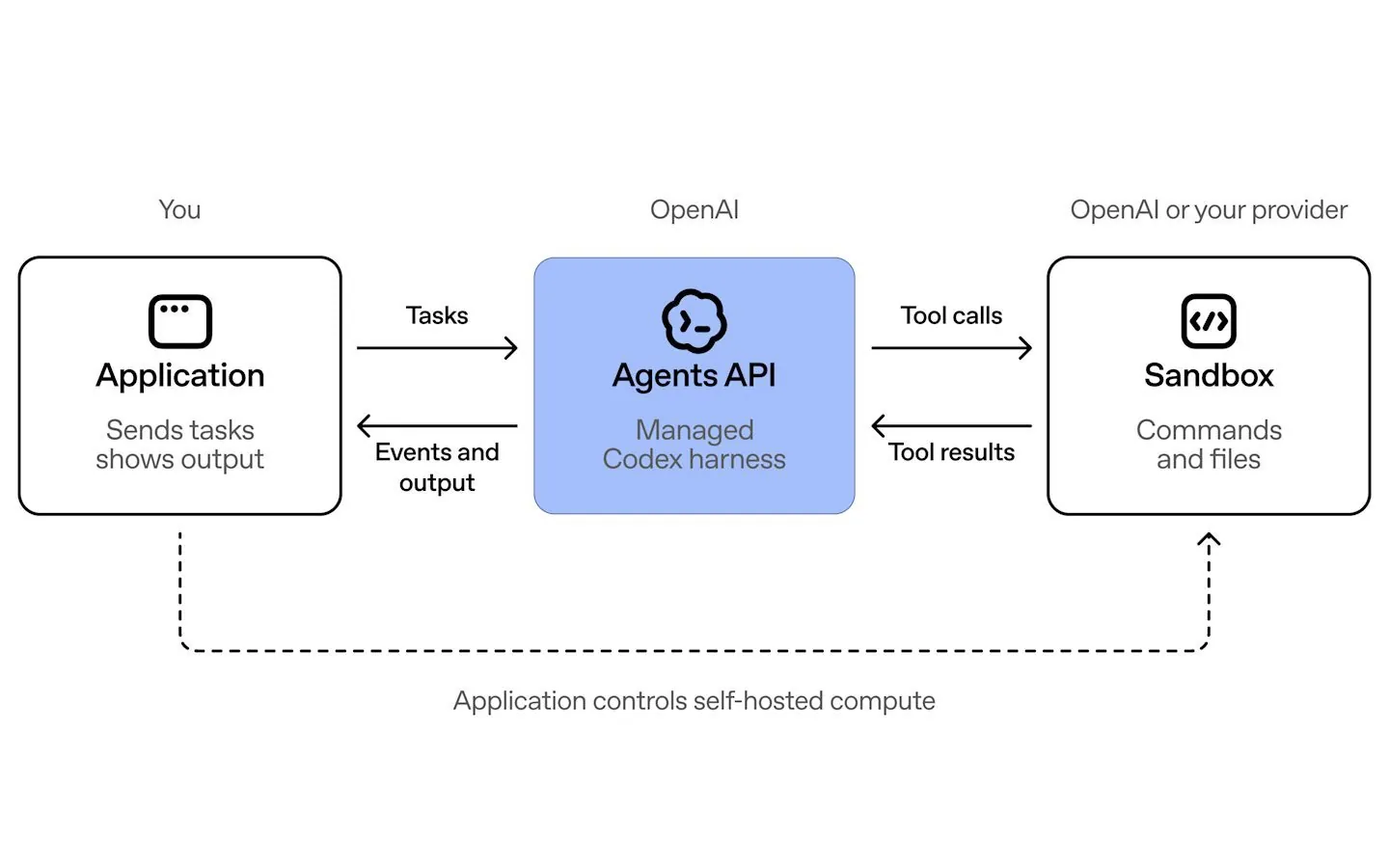
OpenAI has opened the Agents API in public beta, giving developers a managed way to run cloud agents with the same Codex harness and supporting infrastructure that OpenAI uses for long-running work. The company described the release in its official OpenAI Developer Community announcement, positioning the API as a layer for applications that need tools, files, code execution, and persistent agent work rather than a single model response.
OpenAI says a production agent can be created through one API call that specifies the task, model, tools, and environment. Its Agents API documentation describes the available deployment choices, which include an OpenAI-managed sandbox, a developer’s own infrastructure, and partner environments. The company is working with Blaxel, Cloudflare, Daytona, DigitalOcean, E2B, Modal, Oracle, Runloop, and Vercel on those integrations.
The harness is the product layer
The release is less about introducing another model endpoint than about packaging the operational layer around an agent. OpenAI hosts and maintains the harness, while developers choose the compute environment and configure the files, packages, skills, and plugins that the agent can use. The sandboxes are intended to let agents run commands, work with files, and return artifacts without each application team having to build that execution layer from scratch.
OpenAI says the API can automatically compact earlier context as a session approaches its limit. That is designed for work that spans multiple context windows, where a developer would otherwise need to decide what to retain and how to resume. The system also includes tool search, which loads relevant tool definitions as needed, and programmatic tool calling for parallel calls, chained operations, and filtering results before they return to the model’s context.
Those features place the API closer to an agent runtime than a conventional chat completion interface. They also make the environment choice part of the application design. A team can use a fully managed sandbox, run inside its own virtual private cloud, or select a provider with a particular balance of CPU, GPU, memory, storage, cold-start time, and cost. OpenAI’s announcement does not claim that one environment is best for every workload.
Open source harness, paid model and tool use
The Agents API supports MCP, custom functions, and built-in tools such as web search. It also supports multi-agent workflows, allowing a main agent to delegate separate pieces of a complex task to subagents that keep their own context. That approach should be familiar to readers following the shift from individual model calls to coordinated software systems, a thread we examined in our guide to WordPress 7.1’s Abilities API and our report on Google Antigravity’s team-based agents.
OpenAI says the harness is based on the open-source Codex project, so developers can inspect the core coordination logic even though OpenAI operates the hosted service. The company is charging no separate Agents API fee during the beta. Developers pay for the tokens and tools their agents use under the applicable pricing, which leaves the final cost dependent on model choice, context length, tool activity, and the selected sandbox.
The public beta is available to all developers now. OpenAI says it expects to iterate toward general availability, making the next phase less about whether agents can call tools and more about how reliably teams can run them for hours or days with controlled access to data, compute, and external actions.