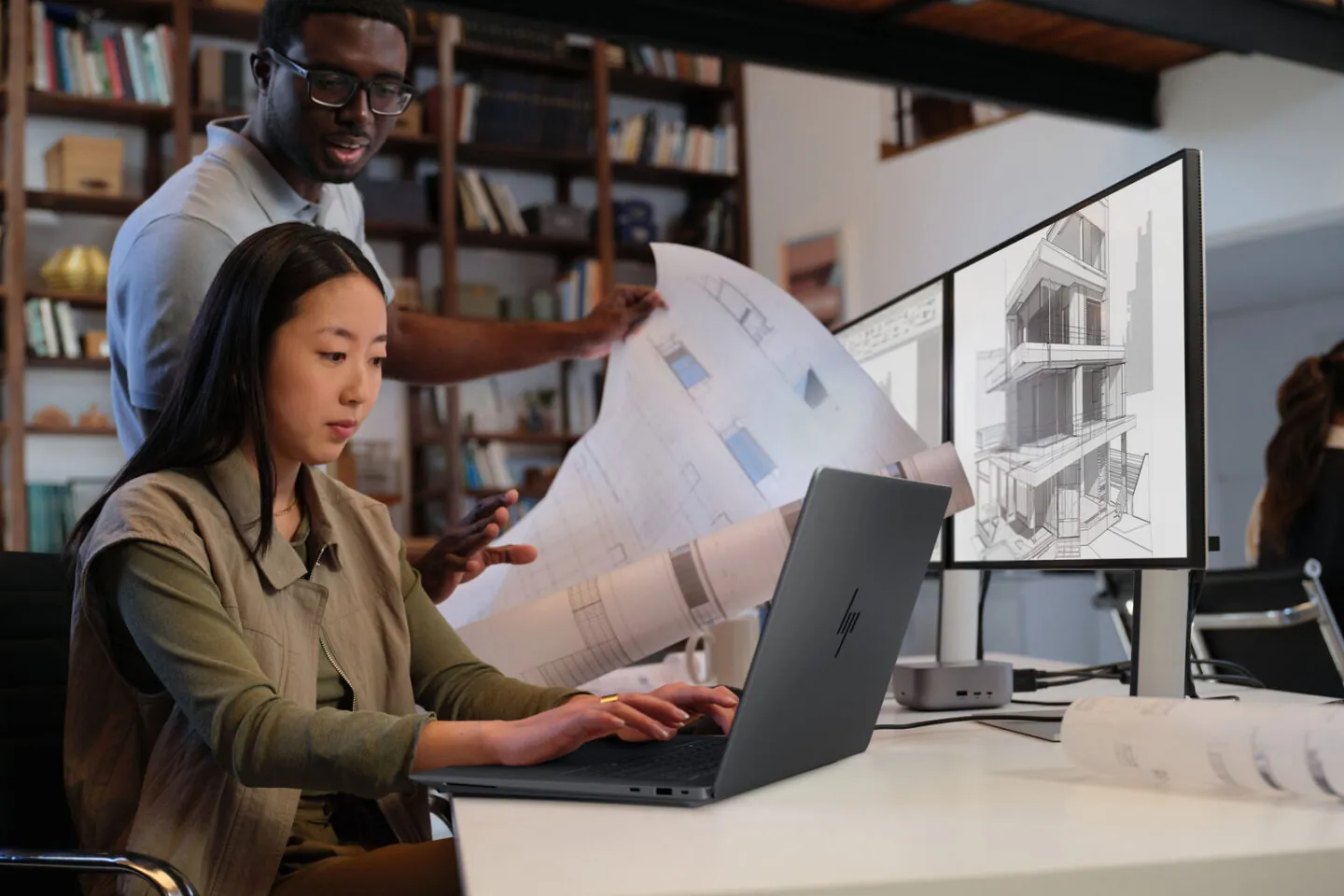
HP has announced the ZBook Ultra G3a 16, a mobile workstation designed to run large AI models and professional software locally. In its September 15 release distributed by GlobeNewswire, HP says the AMD-powered system can be configured with up to 192GB of unified memory and run language models with as many as 300 billion parameters on the device.
The workstation is aimed at architects, engineers, designers and other users who need local AI alongside demanding applications. HP says the ZBook Ultra G3a combines a Ryzen AI Max+ PRO 495 processor, Perplexity Computer and support for Autodesk Revit, with the option to use a cloud model when a task needs frontier capability. The system is expected in October 2026, and HP has not yet announced pricing.
Memory is the headline specification
The ZBook Ultra G3a’s local-AI pitch is built around memory capacity rather than a standalone accelerator card. HP lists up to 192GB of unified memory, with up to 160GB available as dedicated graphics memory, alongside an AMD Radeon integrated GPU and a 55 TOPS NPU. That combination is intended to give local models and graphics workloads room to run together, although the usable capacity and performance will vary by configuration and software.
HP says the machine can run complex AI models, agents and professional applications simultaneously. It describes the hardware as a single-chip system that can keep design work and local inference on the workstation instead of moving every step to a remote service. That can help with latency, privacy and cloud costs, but HP’s announcement is not a benchmark of sustained model generation or a guarantee that every 300-billion-parameter model will fit comfortably in every workload.
Our local AI hardware-fit tool makes a similar boundary explicit: memory estimates are not claims about tokens per second, thermals, driver support or model compatibility. The ZBook’s maximum memory figure is therefore best read as a capacity option for developers and professionals who understand the model and runtime they plan to use, not as a promise that every application will perform equally well.
A workstation with an agent layer
HP is pairing the hardware with Perplexity Computer, which it says comes preloaded and supports an Autodesk Revit integration through a Windows MCP Connector. The company describes task-based Skills co-developed with Perplexity for HP customers. Those tools are meant to connect an agent to defined professional workflows rather than leave users assembling models, connectors and prompts from scratch.
The ZBook Ultra G3a is listed at 4.2 pounds and 17.9 millimeters thick. HP says a new thermal design raises the maximum thermal design power from 55W on the ZBook Ultra G1a to 100W on the G3a, an 81.8% increase. The release also lists secure 5G through HP Go and an IT-replaceable keyboard, details that frame the product as a mobile workstation rather than a portable development board.
That local-first positioning connects to the question in our NPU, GPU and CPU explainer: a workstation can divide work between general-purpose cores, integrated graphics and an NPU, but the best split depends on the model, application and power envelope. HP’s product announcement supplies the available hardware and software pieces; independent testing will have to show how they behave under long sessions.
HP has not published a starting price, battery-life figure or independent performance result for the ZBook Ultra G3a. Availability in October will provide the next concrete checkpoint for a machine pitched as a personal AI workstation, especially for buyers deciding whether local memory capacity is worth more than a conventional laptop’s lower cost and lighter workload.