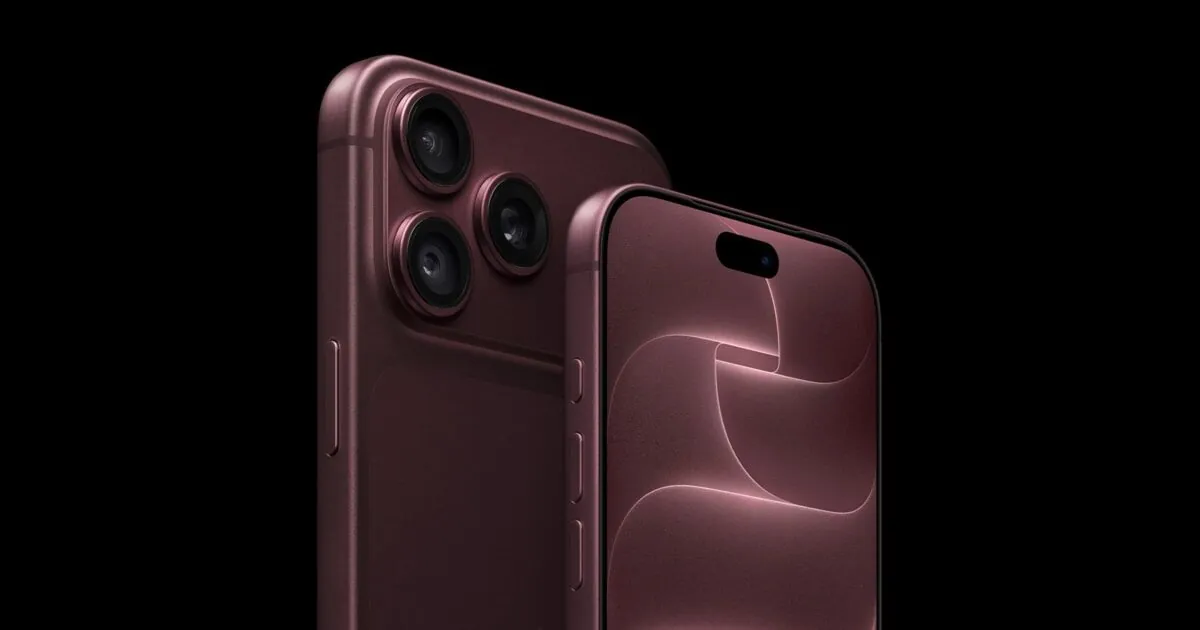
Apple has put its next iPhone generation on a more explicit AI footing. In its September 9 announcement, the company says the iPhone 18 Pro and iPhone 18 Pro Max combine the new A20 Pro chip, higher memory bandwidth, a larger Neural Engine, and Siri AI features that can use personal context.
The iPhone 18 Pro models are scheduled to arrive on September 18, following preorders on September 12. Apple lists black, silver, glacier, and burgundy finishes, with storage options from 256GB through 2TB. The launch gives the company a new hardware platform for the iPhone 18 Pro lineup, while the software side arrives with iOS 27 on September 14.
A20 Pro makes bandwidth part of the pitch
The A20 Pro is built using what Apple describes as the latest 2-nanometer process technology. Apple says the chip has 50 percent more memory bandwidth than the A19 Pro, alongside a six-core CPU with integrated Neural Accelerators and a seven-core GPU that is up to 40 percent faster than the previous Pro chip in the company’s testing.
Apple also describes a Dual 16-core Neural Engine. That is the part of the package most directly aimed at on-device machine learning, although the company does not publish a single cross-application performance score for Siri AI in this announcement. The extra bandwidth matters because local AI work repeatedly moves model data through memory. Our NPU explainer covers why a dedicated neural processor is different from a general-purpose CPU or GPU, while our NPU versus GPU versus CPU guide breaks down how those engines divide work.
The processor changes are not only about AI. Apple says the iPhone 18 Pro introduces a new 48-megapixel Fusion Main camera with variable aperture, six laser-cut blades, and a new computational imaging pipeline. Users can adjust aperture, shutter speed, and white balance, and use a histogram to check exposure. Those controls make the camera a separate hardware story from the Neural Engine, even if both benefit from the new silicon.
Siri AI arrives with clear limits
iOS 27 adds the next generation of Apple Intelligence and an all-new Siri. Apple says Siri AI can use personal context from messages, email, and photos, understand what is on the screen, and take actions related to that content. The company says Apple Intelligence combines on-device processing with Private Cloud Compute when cloud capacity is needed.
The rollout is not universal. Apple says Siri AI will launch as a beta on September 14 for supported devices set to English. French, Japanese, Korean, Portuguese, and Spanish support is planned for October, and some functions will vary by region or language. Apple also says Siri AI will not initially be available in the European Union on iOS, iPadOS, and watchOS.
That combination makes the iPhone 18 Pro a useful test of Apple’s local AI strategy. The company is not presenting the Neural Engine as a standalone benchmark product. It is tying the A20 Pro to camera processing, battery life, private on-device work, and a more capable assistant. That is close to the argument in our local AI hardware analysis: the value of dedicated silicon appears when software can use it without sending every task to a remote server.
Apple says the iPhone 18 Pro Max can provide up to 30 hours of usage on a full charge under its stated testing conditions, and that five minutes of wired charging can provide around seven hours of video playback. Both models are listed with 40 percent recycled content overall, including recycled cobalt in the battery and recycled aluminum in the enclosure. The first public checkpoint is September 14, when iOS 27 and the Siri AI beta begin rolling out, followed by hardware availability on September 18.