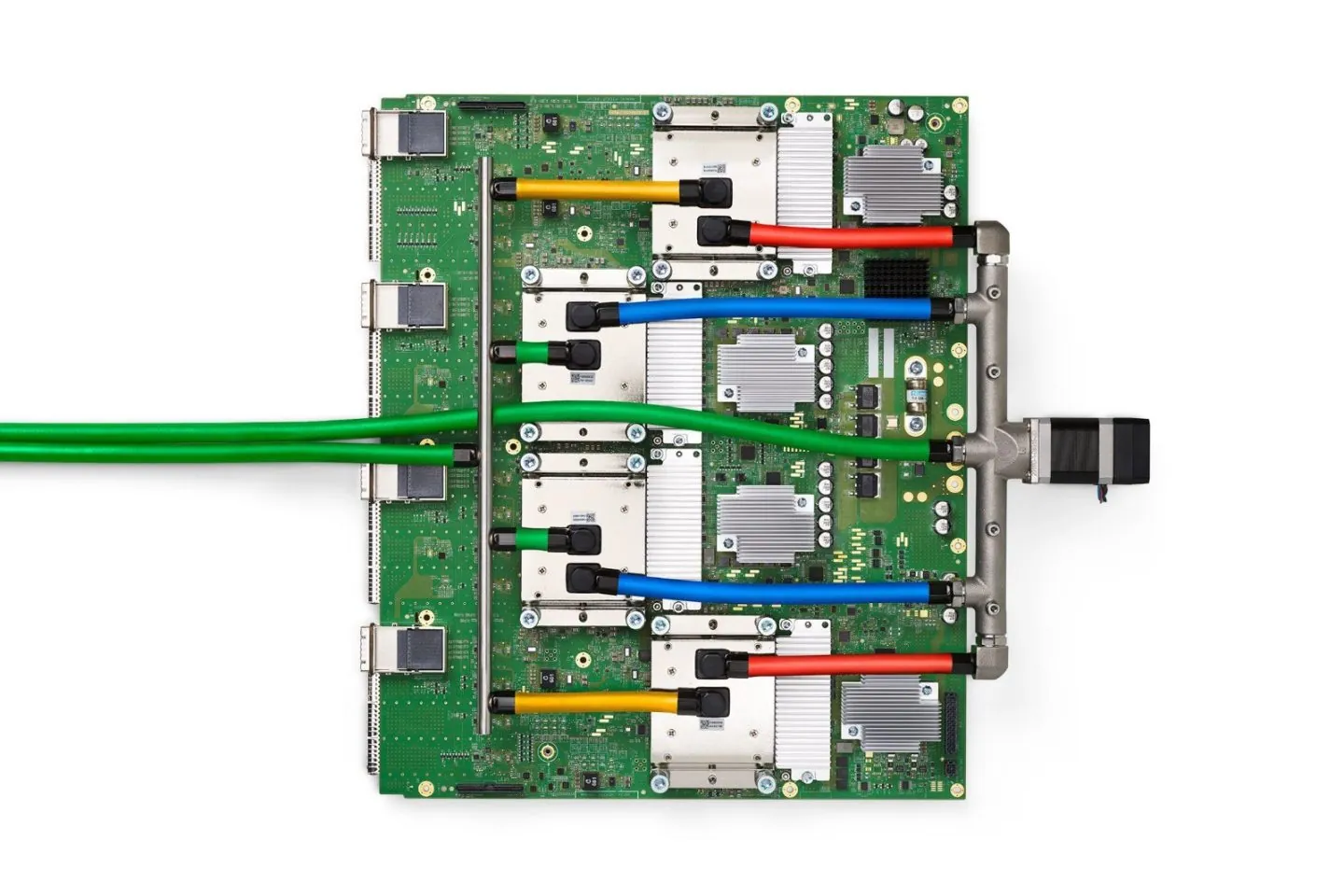
A TPU, or tensor processing unit, is Google’s own AI accelerator. Google’s documentation describes TPUs as custom-developed application-specific integrated circuits built to speed up machine learning, with hardware designed for the large matrix operations that dominate neural networks. Google rents TPU capacity through Google Cloud, where its product page lists which generations are generally available and which are still coming.
A GPU is a general-purpose parallel processor that runs graphics and a wide range of AI code. A TPU is narrower. Google’s own guidance points TPUs at models dominated by matrix math, large models with large batch sizes, and training runs that last weeks or months. It lists frequent branching, high-precision arithmetic and custom operations inside the main training loop as poor fits. For the processors inside laptops and phones, see our NPU vs GPU vs CPU guide. This page covers the data-center chips: which generation does what, how TPU 8t and TPU 8i differ, and where you can rent capacity at a published price.
TPU generation tracker
Last checked 30 October 2026. Specs are the headline figures on Google’s Cloud TPU documentation page for each version. Zones come from Google’s TPU regions and zones list. Status dates come from the Cloud TPU release notes and Google’s launch posts. Prices are the on-demand rate in US dollars per chip-hour from the Cloud TPU pricing page, for the region named, which is the lowest on-demand rate Google lists for that version. TPU 8t and 8i per-chip figures come from the “at a glance” table in Google’s technical deep dive.
| Generation | Role | Headline spec Google publishes | Where available | Status | On-demand price per chip-hour |
|---|---|---|---|---|---|
| TPU v4 | Older generation; Google recommends GKE or moving to a newer version | 275 TFLOPS peak (bf16 or int8), 32 GiB HBM2, 4,096-chip pod | Google Cloud, zone us-central2-b only; quota requests are approved manually | Still offered; current docs give no GA date | $3.22 (us-central2, Oklahoma) |
| TPU v5e | Training and inference | 197 TFLOPS bf16, 16 GB HBM, 256-chip pod | Google Cloud: us-central1, us-south1, us-west1, us-west4, europe-west4 | GA, 9 November 2023 | $1.20 (us-central1, Iowa) |
| TPU v5p | Training | 459 TFLOPS bf16, 95 GiB usable HBM (96 GiB physical), 8,960-chip pod | Google Cloud: us-central1, us-east5, europe-west4 | GA, 9 April 2024 | $4.20 (us-east5, Columbus) |
| v6e (Trillium) | Training, fine-tuning and serving | 918 TFLOPS bf16, 32 GB HBM, 256-chip pod | Google Cloud: US zones plus europe-west4, asia-northeast1 and southamerica-west1 | GA, 16 December 2024 | $2.70 (us-east1, South Carolina) |
| TPU7x (Ironwood) | Large-scale training and inference | 2,307 TFLOPS bf16 (4,614 FP8), 192 GiB HBM, 9,216-chip pod | Google Cloud: zones us-central1-c and us-central1-ai1a | Preview 24 November 2025; GA 31 March 2026 | $12.00 (us-central1, Iowa) |
| TPU 8t | Large-scale pre-training and embedding-heavy workloads | 12.6 PFLOPS FP4 and 216 GB HBM per chip; 9,600-chip superpod with 2 PB of shared HBM and 121 exaflops (Google does not name the format; ServeTheHome reports it as FP4) | Google Cloud once released; OCI from calendar 2027 (generation not stated) | Announced 22 April 2026; “Coming soon” on Google’s TPU page; Google said GA later in 2026 | Not published |
| TPU 8i | Post-training and inference | 10.1 PFLOPS FP4, 288 GB HBM and 384 MB on-chip SRAM per chip; pod of up to 1,024 active chips | Google Cloud once released; OCI from calendar 2027 (generation not stated) | Announced 22 April 2026; “Coming soon” on Google’s TPU page; Google said GA later in 2026 | Not published |
Two cautions on the table. Google notes that its pricing page can show a region where no public TPU zone is generally available, so the zone list is the better guide to where you can actually create a TPU. Ironwood, for example, has a London price but only Iowa zones. And HBM figures mix units because Google’s pages do: the v5e and v6e pages list HBM in GB, while the v5p, v4 and Ironwood pages use GiB, and Google’s Ironwood page lists v6e as 32 GiB.
The table starts at v4. Google still lists TPU v2 and v3 in a few zones in us-central1 and europe-west4, plus v2 in asia-east1, and still prices them, from $1.2375 per chip-hour for a v2 device in europe-west4 to $2.20 for a v3 device. We leave these two older generations out of the comparison.
What the published prices work out to
Google bills TPUs per chip, so the useful unit is the machine you will rent. The pricing page itself gives one example: a TPU v4 host with four chips shows as $12.88 per hour on demand. The same arithmetic on the rates above:
| Generation and region | On demand | 1-year commitment | 3-year commitment | On-demand cost per 100 peak bf16 TFLOPS, per hour |
|---|---|---|---|---|
| TPU v4, us-central2 | $3.22 | $2.0286 (37% less) | $1.449 (55% less) | $1.17 |
| TPU v5e, us-central1 | $1.20 | $0.84 (30% less) | $0.54 (55% less) | $0.61 |
| TPU v5p, us-east5 | $4.20 | $2.94 (30% less) | $1.89 (55% less) | $0.92 |
| v6e (Trillium), us-east1 | $2.70 | $1.89 (30% less) | $1.22 (55% less) | $0.29 |
| Ironwood, us-central1 | $12.00 | $8.40 (30% less) | $5.40 (55% less) | $0.52 |
On those list prices, an eight-chip v6e host costs $21.60 an hour on demand, and a four-chip Ironwood machine costs $48.00 an hour on demand or $21.60 an hour on a 3-year commitment. Per 100 peak bf16 TFLOPS, Trillium is the cheapest of the five at about $0.29 an hour, against $0.52 for Ironwood and $0.92 for v5p. Peak TFLOPS is a spec-sheet number, not measured throughput, and it ignores memory: Google’s Ironwood announcement says it carries six times Trillium’s HBM per chip, which matters more than raw compute for large models and long contexts.
TPU 8t or 8i?
Google built the eighth generation as two chips and says each can run other workloads, but that specialization brings efficiency gains. The guide below follows Google’s own descriptions in its April 2026 announcement and technical deep dive. We found no independent benchmarks of either chip as of 30 October 2026, so every relative figure here is Google’s claim against Ironwood.
| Your job | Google’s fit | What Google says the chip does for it |
|---|---|---|
| Pre-training a large model across thousands of chips | TPU 8t | 9,600 chips per superpod on a 3D torus, with the new Virgo network linking more than 134,000 chips in one fabric. Google claims nearly 3x the compute per pod and up to 2.7x the performance per dollar of Ironwood for large-scale training. |
| Embedding-heavy models such as ranking and recommendation | TPU 8t | Keeps the SparseCore, which handles the irregular memory access of embedding lookups. |
| Training on low-precision formats or very large datasets | TPU 8t | Adds native FP4, and TPUDirect Storage with Managed Lustre, which Google says gives 10x faster storage access than training on Ironwood. |
| Low-latency serving of large mixture-of-experts models | TPU 8i | Boardfly topology cuts the worst-case path in a 1,024-chip pod from 16 hops to seven. Google claims up to 80% better performance per dollar than Ironwood at low-latency targets. |
| Long-context decoding and reasoning chains | TPU 8i | 384 MB of on-chip SRAM, three times the previous generation, to keep more of the KV cache on the chip, plus 288 GB of HBM. |
| Reinforcement learning and other post-training | TPU 8i | Google’s TPU page describes 8i as optimized for post-training and inference. A Collectives Acceleration Engine replaces the SparseCores and, Google says, cuts collective latency up to 5x. |
| A job that has to start this year | Ironwood or Trillium | Neither eighth-generation chip had a price or a generally available date when we checked. Google says JAX, PyTorch and Keras code that runs on Ironwood scales to the new chips. |
Both chips use Google’s Arm-based Axion CPUs as hosts, support JAX, PyTorch, vLLM and SGLang, and, according to Google, deliver up to twice the performance per watt of Ironwood. The Register’s launch report describes the same split, with the training chip aimed at scale and the inference chip trading some compute for more SRAM and memory.
Where to rent TPU capacity
Google Cloud. Google lists Compute Engine, Google Kubernetes Engine and Gemini Enterprise Agent Platform as the ways to use TPUs, and marks the older Cloud TPU API as deprecated. The pricing page sets out the buying options:
- On demand: billed hourly for actual use. Google pitches it at short experiments and benchmarks.
- Spot: unused capacity at lower rates. Spot prices can change up to once every 30 days, and Google’s Spot VM page says the machines can be preempted at any time and must be recreated afterward.
- 1-year and 3-year commitments: billed monthly on reserved quota. Google positions the 1-year term at 32 to 512 cores and the 3-year term at 512 cores or more.
- Dynamic Workload Scheduler: Flex-start and calendar mode have their own per-chip-hour rates on the pricing page, at $6.00 and $8.40 for Ironwood in us-central1. The release notes that announced them as previews in 2025 say Flex-start provisions TPUs for up to seven days without a long-term reservation, and calendar mode reserves them for 1 to 90 days.
For a free first test, Google’s Colab FAQ says the free notebook service includes TPU runtimes, though the TPU types on offer vary over time.
Oracle Cloud Infrastructure, from 2027. On 27 October 2026, Oracle and Google announced that Google TPUs will be available on OCI in calendar year 2027, ramping over a multi-year period, and called it the first time Google TPUs will be offered on a hyperscale cloud outside Google. A joint post on Google Cloud’s blog, bylined by Karan Batta, Senior Vice President of Oracle Cloud Infrastructure, and Gurmeet Goindi, says the two companies will deploy TPU capacity on OCI starting in calendar 2027. Oracle’s release describes TPU 8t and TPU 8i as part of Google’s portfolio, but neither company names the generation OCI will deploy first, its regions, its instance shapes or its prices. The Register’s report on the deal notes that Oracle did not give the quantity of TPUs coming.
Until OCI publishes those details, the only TPU price list we found is Google Cloud’s, and its lowest on-demand rate is a v5e chip at $1.20 an hour in us-central1.
How this tracker is kept
We update the tables above when a TPU generation changes status or when Google or Oracle publishes a new price. The figures on this page were last checked on 30 October 2026.