
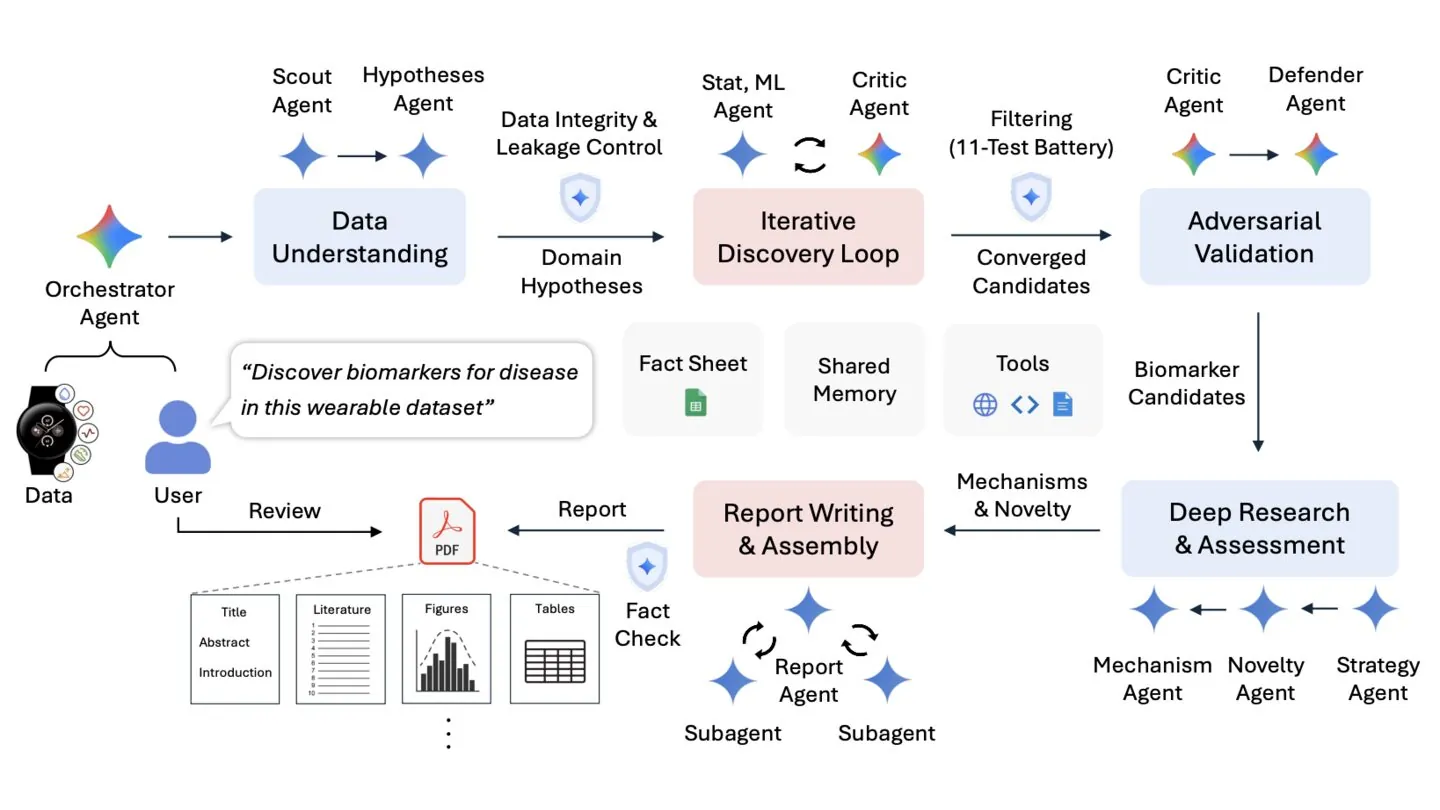
Google Research has introduced a multi-agent system that ranks candidate biomarkers from wearable sensor data, while keeping statistical analysis and human review in the loop. The Google Research announcement published August 21 calls the system the Biomarker Discovery Framework and links to an accompanying research paper.
The framework is designed for a problem that ordinary language-model agents handle poorly: physiological time series can produce attractive correlations that fail under leakage checks, multiple-testing corrections or a new cohort. Google’s paper describes a workflow that separates deterministic numerical analysis from generative reasoning, so the agents can propose and interpret hypotheses without treating an association as proof of a medical cause.
Agents wrapped around statistical checks
The system begins with an orchestrator that turns a research request into an execution plan. Specialized agents map the data, missing values and clinical endpoints, then ground candidate hypotheses in prior literature. Statistical and machine-learning agents construct features, estimate associations and adjust for multiple comparisons. Critic and Defender agents challenge the results for leakage, overfitting, confounding, instability and physiological implausibility.
That architecture is more constrained than the broad automation often implied by the word agent. The framework includes an 11-check adversarial battery and labels candidates as screened, conditional, exploratory, rejected or unstable. Report agents then verify numerical claims against a shared fact sheet before assembling a draft for expert review. It is closer to a supervised research pipeline than an autonomous medical system, a distinction that matters alongside our look at the Abilities API and narrowly scoped AI actions.
Google Research says it evaluated the framework across three cohorts totaling 9,279 participant-observations. The datasets span mental health and metabolic disease, and the pipeline identified 41 candidate digital biomarkers for mental-health outcomes and 25 for metabolic outcomes. In one example, sleep-duration variability in the DWB cohort was associated with PHQ-8 depression severity at Spearman’s rho of 0.252. In the GLOBEM cohort, sleep-onset variability produced a smaller exploratory association with PHQ-4 severity at rho 0.126.
Those numbers are signals to investigate, not clinical tests. Google explicitly describes the cross-cohort pattern as suggestive construct-level convergence rather than direct replication, and says the mechanisms remain literature-grounded hypotheses. When the framework-derived features were combined with demographic variables, the company reports improvements in downstream prediction of 0.040 in R-squared for depression and 0.021 for insulin resistance. The figures come from the study’s own datasets and evaluation design, not from a validated diagnostic product.
Human review remains the release gate
The framework was also tested in a blinded review by 15 experts in medicine, biomedical data science, machine learning, bioinformatics and digital health. Google Research says the system received the highest mean score across seven quality dimensions when compared with Google DeepMind’s AI co-scientist, Biomni and Google’s Data Science Agent. In a separate 13-session evaluation, reviewers ranked it first in nine four-system comparisons.
These results describe report quality and research assistance, not a model diagnosing patients. The practical idea is that AI can widen the search over noisy wearable data if its creative steps are surrounded by reproducible calculations, adversarial checks and domain experts. That focus on keeping sensitive workloads close to their data also connects with our coverage of the local AI hardware case, even though Google’s framework is a research workflow rather than a consumer device feature.
Google’s announcement leaves the next question open: whether these candidate associations remain useful in held-out cohorts and real clinical workflows. For now, the framework is best understood as a structured way to prioritize hypotheses, with human review still responsible for deciding what deserves further study.