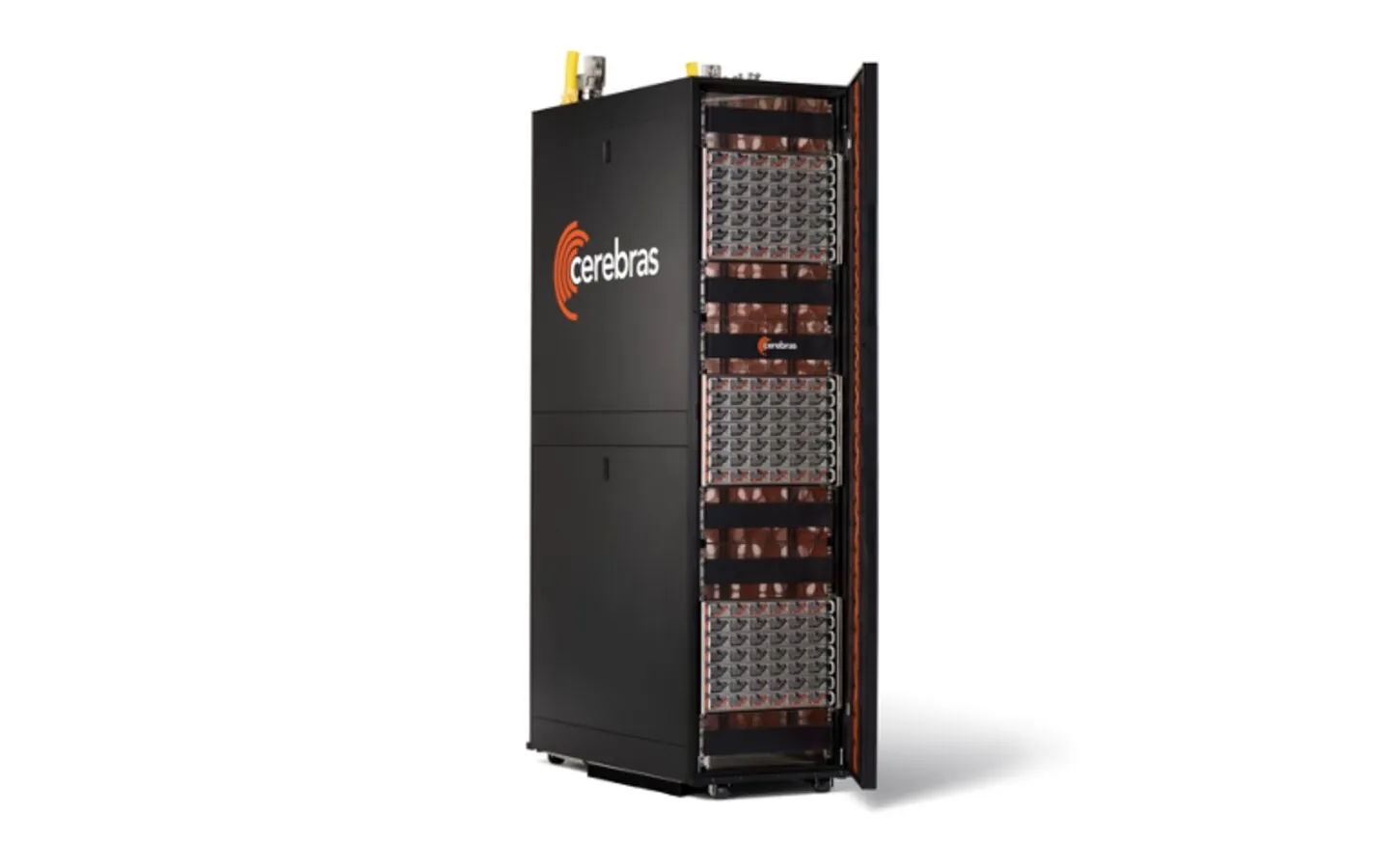
Cerebras has unveiled CS-4, a rack-scale AI system built from three new Wafer Scale Engine 3 Turbo processors. In its August 18 announcement, the company says the system can deliver up to 30 times faster inference than GPU systems, while combining compute, power delivery, cooling, and I/O in a redesigned platform.
The claim is aimed at the part of AI infrastructure that users feel most directly: how quickly a model starts producing useful tokens. Cerebras says CS-4 is designed for interactive reasoning and agent workloads, but it also targets the less visible job of serving many requests inside a fixed power budget. The first systems are scheduled to ship this quarter, according to the company.
A rack built around three wafer-scale processors
CS-4 is the fourth generation of the Cerebras System. Its central processors are three WSE-3 Turbo chips, the latest version of Cerebras’ wafer-scale architecture. Instead of spreading a model across many conventional accelerator boards, the design keeps a large compute surface and its communication fabric close together. Cerebras says the new system reduces wafer-to-wafer interconnect latency to as little as 2 microseconds.
That low-latency link is important for large models because decoding requires a constant exchange of state between processors. Cerebras says CS-4 can generate more than 1,000 tokens per second on models exceeding 10 trillion parameters. The company labels that figure as an extrapolation from internal benchmarking, rather than a general result that applies to every model or deployment.
The system is built on Cerebras’ Nexus Platform Architecture, which treats compute, power, and I/O as separate modules inside the rack. A rear-mounted Wafer-Scale Backpack combines power conversion, liquid cooling, high-speed I/O, and control electronics around the wafer. Cerebras says the design uses 50 percent fewer components than its previous-generation system and increases automated manufacturing by 60 percent. Those are manufacturing and architecture claims from the vendor, not measurements from an independent teardown.
Speed claims need a workload beside them
Cerebras reports up to 30 times faster inference across the model set shown in its announcement, with comparisons attributed to Artificial Analysis and internal benchmarking from August 2026. It also claims up to 10 times more token capacity per watt than CS-3 and up to twice the performance of the previous system. The company’s own qualification matters: the page says observed gains against GPU systems can vary with the workload, configuration, date, and models being tested.
That makes CS-4 notable even before the headline number is tested outside Cerebras’ chosen configurations. The system is also designed for disaggregated inference, where one platform handles prompt processing, or prefill, and CS-4 handles the low-latency decode phase. Cerebras lists AMD Helios and AWS Trainium as possible complementary prefill platforms. In theory, that lets operators combine efficient batch processing with a specialized decode engine instead of asking one type of accelerator to do every job.
The design follows the hardware pressure we outlined in our memory bandwidth guide: feeding the compute is as important as adding more compute. Cerebras’ wafer links and power-delivery changes are an attempt to reduce the cost of moving data through the rack. The modular approach also fits the infrastructure market covered in our neocloud analysis, where operators want systems that can be installed and expanded in repeatable blocks.
It is a different strategy from the general-purpose accelerator comparisons in our TPU explainer. CS-4 is not presented as a replacement for every GPU or ASIC. Cerebras is selling a tightly integrated system for high-speed inference, and its performance case depends on how a provider divides prefill, decode, networking, and power across a real deployment.
The next milestone is delivery. Once the first CS-4 systems reach customers, independent measurements across comparable models and power limits will show how much of the 30x claim comes from the architecture and how much comes from the selected workload. For now, Cerebras has put a specific rack design, a shipping window, and a set of testable performance claims on the table.