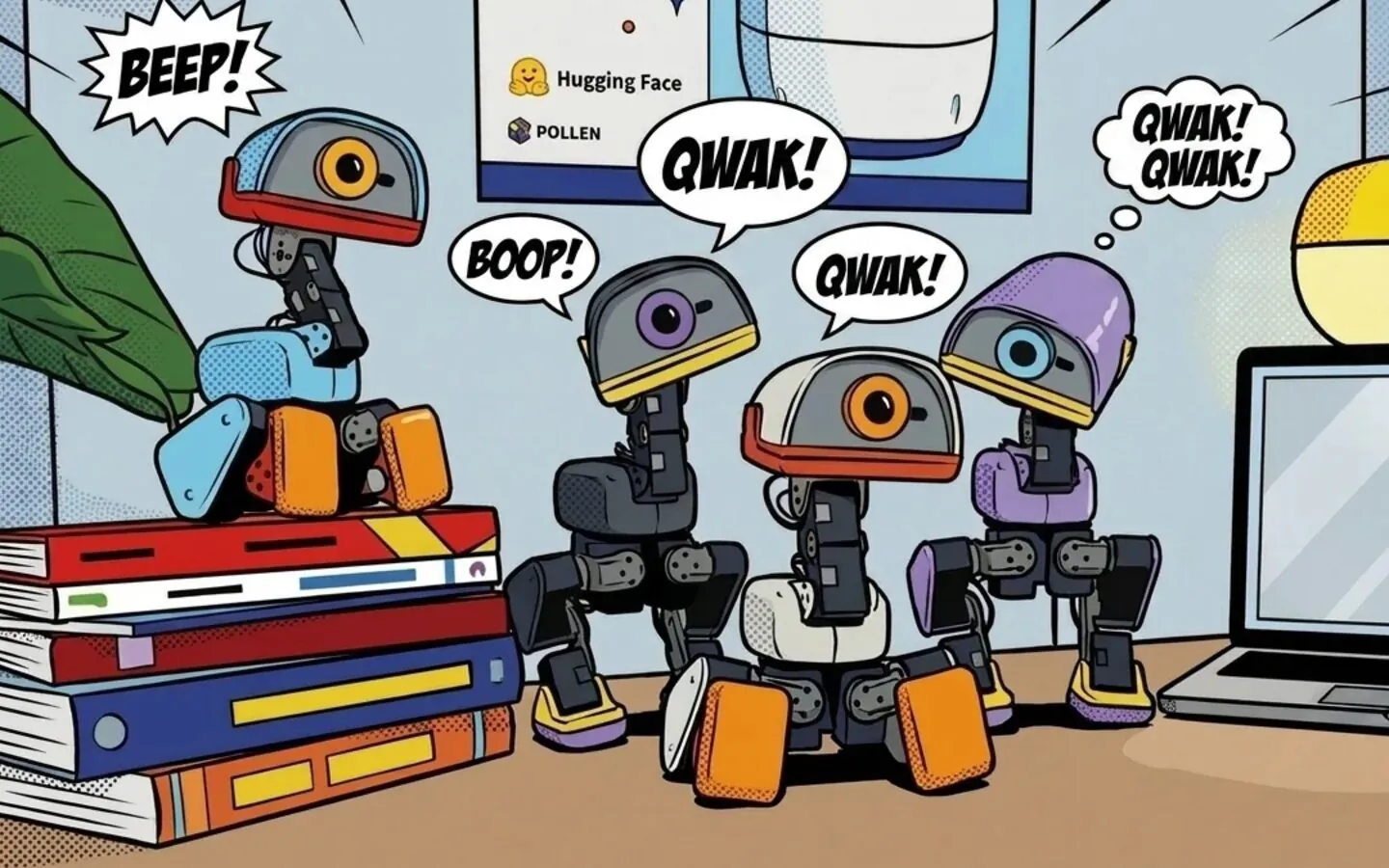
Pollen Robotics has launched Microduck, a small open robot designed to make physical-AI experiments easier to run. In its August 27 announcement, the company describes a 25-centimeter biped with 15 motors, a camera, a small depth sensor, two IMUs, and an articulated beak that can pick up objects.
Microduck weighs less than 800 grams and is available for preorder at $399 before taxes and shipping. Pollen says the robot can walk, sit, crouch, recover from many common falls, and roller-skate. First deliveries are targeted before Christmas 2026 in North America, Europe, and the United Kingdom.
Built for the action side of physical AI
Pollen positions Microduck as a different kind of small robot from its Reachy Mini. Reachy Mini is centered on seeing, listening, speaking, and expressive human-robot interaction. Microduck starts with the harder mechanical question: how to teach a machine to move, fail, recover, and transfer a behavior from simulation to a real body.
That makes the robot a compact training platform rather than just a desktop novelty. Pollen says its small size and light weight make failed movement experiments easier to reset and safer to run at home, in classrooms, or on a workbench. The company also wants the first interaction to be immediate, with learned behaviors that let owners drive it with a gamepad, make it follow a laser dot, trigger movements, or let it react to its surroundings.
The approach connects with the problem we examined in our guide to repeatable robot training in Isaac Sim. Simulation is useful only when a policy can survive the gap between a clean virtual environment and a physical machine. A small robot that can be knocked over, observed, and reset quickly gives developers a practical loop for testing that gap.
An open stack for simulation and sim-to-real work
The software is as important as the hardware. Pollen says the open-source stack covers robot control, simulation, reinforcement learning, and sim-to-real deployment. Its public Microduck repository contains the SDK and robot software, while the separate Microduck RL repository contains training environments and tools for moving learned policies onto the robot.
The RL repository describes a MuJoCo Warp and PPO training setup. It says policies are trained at 50 Hz, exported to ONNX, and deployed by the runtime in the main Microduck project. That gives the project a more concrete development path than a hardware kit that only exposes motors and sensors. Developers can inspect the environments, change a reward or behavior, export a policy, and compare the result with the machine on the desk.
The runtime design also makes the robot a useful counterpoint to the scheduling issues in our coverage of ROS 2 executors. Physical behavior depends on more than a model’s output. Sensor reads, motor commands, fall recovery, camera streams, and safety checks all have to meet timing requirements at once.
Microduck comes in Cream, Graphite, Lavender, and Sky. The $399 preorder price is before taxes and shipping, and Pollen’s delivery target is not a guarantee of availability on a specific day. The immediate opportunity is for developers who want an approachable legged platform, public training tools, and enough mechanical personality to make repeated experiments less intimidating.