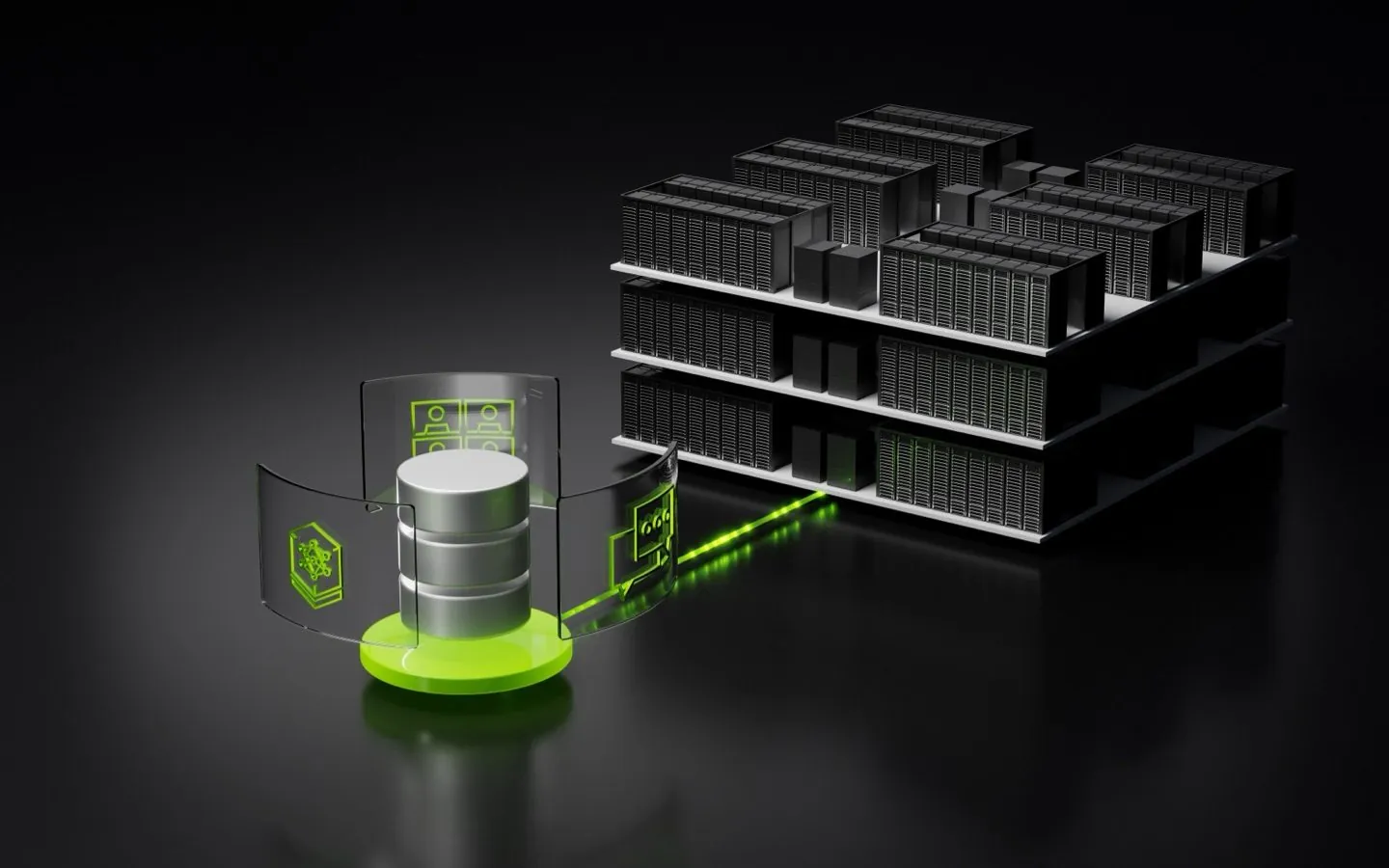
Nvidia announced at the Future of Memory and Storage (FMS) conference this week that it is open-sourcing cuFile, the API that lets GPUs read from and write to storage directly, together with the vertical storage software stack underneath it. The company detailed the move in a blog post published August 4, framing storage as an active part of the AI data path rather than a passive repository.
cuFile is an open source component of Nvidia’s GPUDirect Storage technology. Instead of routing every storage request through the host CPU, the API lets device code initiate transfers directly, using GPU threads and high-bandwidth memory to reach data outside system memory. Nvidia says the approach cuts storage access times to microseconds.
The project’s new home is the XIO-SIG organization on GitHub, where Google, Intel, Meta, and Nvidia serve as founding maintainers. Nvidia describes the release as part of an effort to unify a security-first storage stack built on Linux best practices, with the APIs open to external contributions.
The timing tracks where AI workloads are straining. Nvidia says AI agents are generating large volumes of storage traffic, and GPUs can now initiate storage requests directly, producing thousands of concurrent operations that storage systems must encrypt, compress, verify, and reconstruct at the same time. Inference workloads in particular issue millions of small random reads per second as systems serve KV cache entries, embeddings, and vector search results, a pattern that kept the CPU in the path of every operation under the older host-mediated model. For GPU-to-GPU communication Nvidia had already removed the host from the loop with NVSHMEM, which lets device code initiate transfers directly, but storage kept the host-mediated model: a read from an NVMe drive still returned control to the CPU, ran the file system, and waited for completion. It is the same data-path pressure behind the argument that memory bandwidth has become the new bottleneck in AI hardware.
Alongside the open source release, Nvidia formally launched Storage-Next, an initiative first discussed publicly since GTC 2025. The group now includes more than 40 storage and flash vendors, among them DDN, Kioxia, and Micron, plus controller manufacturers, cooling specialists, and standards organizations. Participants are collaborating on how storage devices should behave when a GPU, rather than a CPU, is the client, with the aim of translating the results into open industry standards.
Nvidia also pointed to compute gains inside the storage path itself. In benchmarks shared with the announcement, the Vera CPU, part of the Vera BlueField-4 STX storage processor, delivered up to 3.21x higher throughput than an x86 CPU in a two-stage compression and encryption pipeline. Nvidia says that lets storage platforms absorb heavy AI traffic with significantly less compute infrastructure.
Storage as a Security Layer
The open source move also carries a security angle. Nvidia argues that fast, secure access to data and storage is a foundation for preventive and detective cyber defense, and that making cuFile openly available keeps security context and data accessible at the speed AI-powered defenses need. The code and the maintainer roadmap are live on GitHub now, while the Storage-Next standards work is expected to continue through the rest of the year.