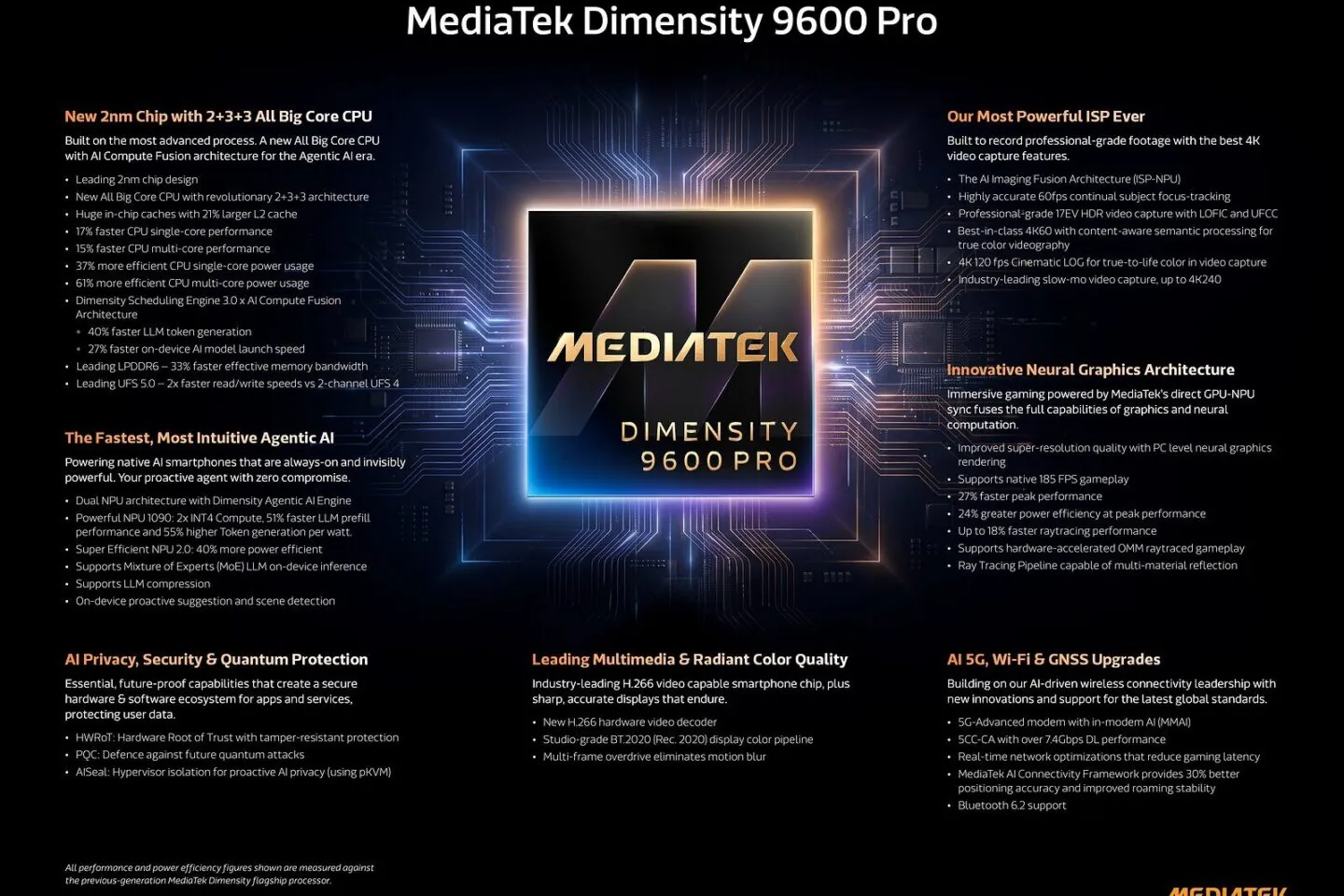
MediaTek has announced the Dimensity 9600 Pro, a flagship smartphone system-on-chip built around a 2nm process and a dual-NPU design. The company’s September 15 announcement positions the chip as a platform for on-device AI, gaming, imaging and everyday mobile computing, with the first phones expected this quarter.
The announcement is a specification sheet and a set of vendor test claims, not an independent review. MediaTek says the new silicon reduces multi-core power consumption by up to 61% versus the previous generation, while its AI features are designed to keep more work on the phone instead of sending every request to a cloud service.
A 2nm design with an all-big-core CPU
The Dimensity 9600 Pro uses a 2+3+3 CPU layout. Two C2-Ultra cores run at up to 4.55GHz, three C2-Pro cores are listed at up to 4.35GHz, and another three C2-Pro cores run at up to 3.1GHz. MediaTek claims up to 17% higher single-core performance and up to 15% higher multi-core performance than the previous generation. The company also reports a 61% reduction in multi-core power consumption, with the footnote specifying that the performance figures came from testing on MediaTek laboratory devices.
The platform adds up to 34.5MB of combined cache and supports LPDDR6 memory and UFS 5.0 storage. Those interfaces will matter to phone makers building high-end devices, but the announcement does not identify a retail handset or promise that every implementation will use the maximum configuration. That distinction is useful when reading a launch specification: the chip sets a ceiling, while a finished phone still depends on its memory, cooling, software and battery choices.
MediaTek is also introducing a Dimensity 9600M alongside the Pro model. The company describes that chip as an upcoming option that carries the Agentic AI Engine, Dimensity Scheduling Engine and HyperEngine features into a broader premium tier. Both chips are expected to appear in smartphones this quarter, although MediaTek has not named the first models in the release.
Two NPUs target local AI workloads
The Pro chip’s dual-NPU architecture separates heavier AI work from lower-power, always-on tasks. MediaTek says its second-generation Super Efficient NPU cuts power consumption for always-on AI by 40%. Its NPU 1090 is rated for 51% higher LLM prefill performance and 55% higher token generation per watt, and the company says the design supports on-device applications using models of up to 30 billion parameters.
Those numbers make the processor relevant to the same hardware question we explore in our NPU versus GPU versus CPU guide: which part of a system should handle a workload, and at what power cost? MediaTek’s figures describe its own lab comparisons, so they should not be treated as a guarantee of sustained performance in a particular phone. Our NPU explainer provides the architectural background without turning an accelerator label into a promise about an end product.
Graphics are part of the pitch as well. The integrated G2-Ultra NX GPU is claimed to deliver up to 27% higher peak performance, 24% lower power consumption at peak performance and 18% faster ray tracing. MediaTek also cites gaming at up to 185 frames per second, but that result will depend on the game, resolution, thermal limits and the phone maker’s software profile.
The Dimensity 9600 Pro therefore arrives as a broad mobile platform rather than a single feature upgrade. The 2nm process, new memory and storage standards, dual NPUs and GPU changes give manufacturers more components to tune for local AI and gaming. The next test is practical: which phones ship with the silicon, how they manage sustained heat, and whether those vendor measurements translate into useful battery life and responsiveness for owners.