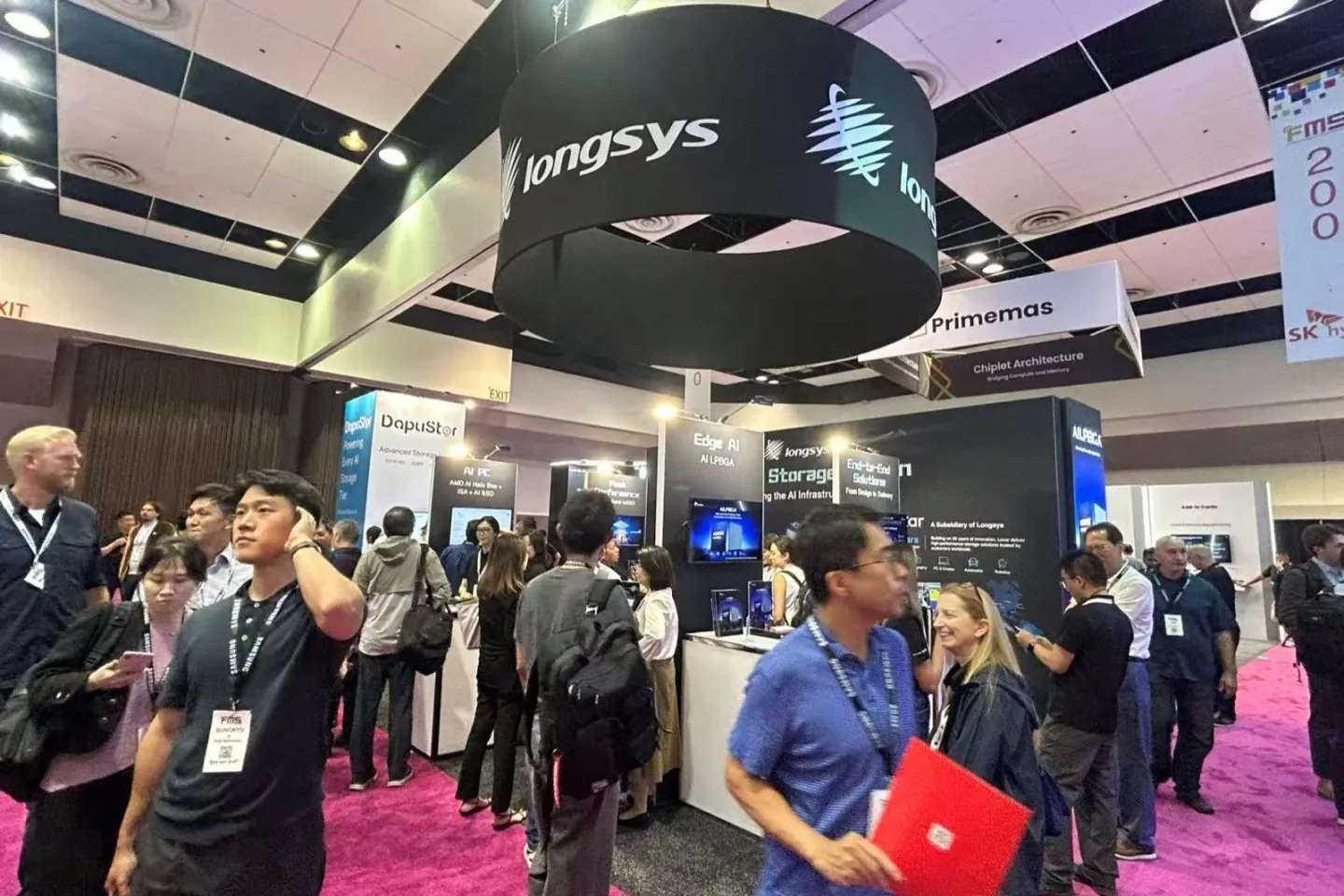
Longsys used the Future of Memory and Storage 2026 conference to present an “Edge AI Storage Fusion” platform spanning AI agent hosts, AI PCs, and embedded mobile devices. In its August 6 announcement, the memory and storage company described a set of products intended to reduce the bandwidth, capacity, and latency limits that appear when larger models move from cloud servers to local hardware.
The showcase combines Longsys’ AIDIMM high-bandwidth memory, AISSD storage, and iSA Intelligent Storage Agent software. Longsys says the combination was co-optimized with AMD and is designed to coordinate memory and storage resources during edge inference. The claims come from the company’s own testing and demonstrations, so they should be read as vendor performance claims rather than an independent benchmark.
Memory and storage share the workload
Longsys says an AI agent host developed with SixUnion can run language models ranging from 70 billion to 122 billion parameters locally with 64GB of AIDIMM memory. The company attributes the result to the combined hardware and software design, which uses storage as part of a larger resource pool instead of treating the SSD as a passive place to keep files.
AIDIMM uses four LPDDR5X memory packages in a single-sided module. Longsys lists a native 256-bit memory interface, peak bandwidth of up to 307.2GB/s, and capacities reaching 128GB per module. The module uses a dedicated high-speed connector intended to simplify integration into AI agent host motherboards.
The iSA software layer adds dynamic mixture-of-experts offloading, hierarchical cache management, and predictive prefetching, according to Longsys. The goal is to move data between DRAM and storage based on what a workload needs at that moment. That could help systems handle larger models than their installed memory would otherwise allow, but the practical result will depend on model architecture, storage latency, software support, and the host platform.
A faster SSD for AI PCs
For AI PCs, Longsys demonstrated a DRAM-less PCIe Gen5 SSD built around its proprietary 5nm Storage Processing Unit. The company reports sequential read speeds of up to 14.8GB/s, sequential writes of 13GB/s, and power consumption of 6.3W or below. It also describes hardware-based lossless compression with a claimed ratio of up to 2:1 for suitable data, including model files and cache data.
Longsys separately lists up to 11GB/s sequential read and 10GB/s sequential write performance for its PCIe Gen5 mSSD media, with random performance reaching 2.2 million read IOPS and 1.8 million write IOPS. The company says the storage can sustain peak performance for 181 seconds under continuous workloads and has manufacturing capacity above one million units per month. Those numbers are configuration-specific and will need independent testing across finished products.
The broader idea is straightforward: local AI is making memory and storage design inseparable. Faster flash cannot replace system memory in every workload, but software-managed caching, compression, and model placement may help manufacturers build smaller systems without abandoning local inference. Longsys’ FMS demonstrations show how storage vendors are targeting that gap before it becomes a hard limit for edge AI products.