WordPress 7.1 arrived on August 19 with a release that is easy to misread. It is not a new chatbot inside the dashboard, and it does not turn every plugin into an autonomous operator. Its more important change for AI builders is quieter: WordPress is making site capabilities easier for software to discover, describe, validate, and execute.
The official WordPress 7.1 Field Guide puts the Abilities API among the release’s main developer changes. The Abilities API documentation describes a standard registry for functions that WordPress, plugins, themes, external tools, and AI agents can understand. Together, those changes give WordPress a more credible foundation for agent-ready site tooling.
The important change is a contract for site abilities
An AI agent needs more than a login and a collection of undocumented endpoints. It needs to know what an operation does, what inputs it accepts, what it returns, and which user is allowed to run it. Without that contract, an agent is forced to guess. Guessing is tolerable for a draft explanation. It is a poor basis for changing a production website.
The Abilities API gives WordPress a place to register these operations. An ability has a name, description, input and output schemas, a category, an execution callback, and a permission callback. A plugin could register a read-only site health check, a product lookup, a content audit, or a tightly scoped publishing action. The important distinction is that the developer defines the boundary before an agent can use it.
That makes an ability different from handing an agent a broad administrator password. A registered operation can reject a request because the input is invalid, because the authenticated user lacks the required capability, or because the operation is not exposed to the requesting client. WordPress 7.1 does not make those decisions for every plugin, but it gives developers a shared place to express them.
Why schemas matter to AI agents
Natural-language instructions are not enough when a tool expects structured data. A model may understand the request to check whether a local model fits a graphics card, but the underlying function still needs a model identifier, memory budget, quantization setting, and context length in predictable forms. A schema turns that expectation into something a client can inspect and validate.
WordPress 7.1 prepares ability input and output schemas for external clients. The JSON Schema compatibility note explains that REST responses now receive portable schemas instead of WordPress-only schema details. The same preparation is used when the WordPress AI Client converts an ability into a function declaration.
This is useful for local AI because it makes the interface more predictable without deciding where the model runs. A locally hosted model can still be the reasoning layer, while WordPress exposes only the narrow site operations that the model is permitted to see. The model provider, authentication layer, and storage policy still determine what data leaves the server. The Abilities API is a contract, not a privacy guarantee.
The execution hooks make automation easier to control
Discovery is only half of the problem. A useful agent integration also needs control points around execution. WordPress 7.1 adds Abilities API filters for the execution pipeline, including short-circuiting an operation, normalizing input before validation, changing how permission results are handled, and transforming or recovering execution results before output validation.
Those hooks let a plugin add a review gate, record an audit event, apply a rate limit, or refuse an operation when the site is in a protected state. A content workflow could allow an agent to prepare a draft while requiring a human to approve publication. A monitoring tool could expose read-only diagnostics but reject any request that attempts to alter configuration.
These controls still need to be designed correctly. A filter is not automatically an audit log, and a permission callback is not a complete incident-response system. Production integrations should define who can call an ability, validate every field, log meaningful decisions, and keep write operations narrower than read operations.
What this could mean for local AI tools
For builders working with local AI, the most interesting possibility is a site that exposes useful context without exposing the whole database. A hardware or model tool could register a read-only ability that returns the current compatibility dataset. A maintenance plugin could expose cache status, WordPress version, or queue health. A publishing assistant could check whether a draft has a category, source URL, excerpt, image, and valid metadata before it is sent for review.
Each of those examples should be a separate, typed operation with a clear permission rule. The agent should not receive a generic “manage the site” tool and be expected to infer the safe path. Narrow abilities are easier to test, easier to revoke, and easier to explain to the person responsible for the site.
WordPress also has an official discussion of the MCP Adapter for WordPress. The adapter maps registered Abilities to the primitives used by the Model Context Protocol, allowing compatible agents to discover tools and resources through a common interface. That adapter is an additional integration layer, not a switch that WordPress 7.1 turns on automatically.
7.1 is not an automatic agent layer
There are several limits worth keeping in view. A plugin must register an ability before an agent can discover it. The developer must provide useful schemas and a permission callback. The client still needs authentication, and the site owner still needs to decide whether an ability is public, user-scoped, or restricted to administrators. Nothing in the release removes the need for approvals around publishing, payments, user data, or configuration changes.
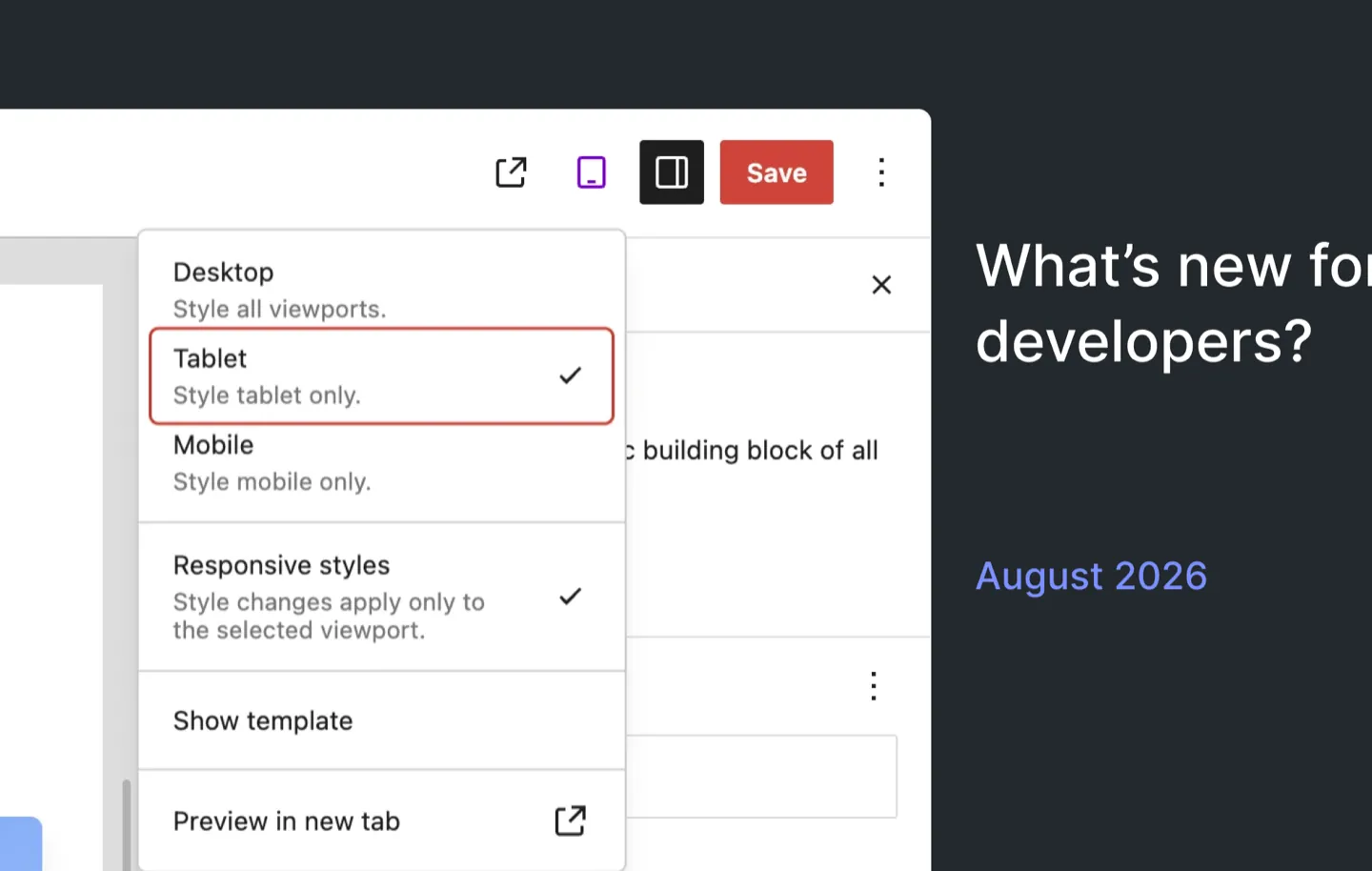
The rest of WordPress 7.1 is broader than AI. The release adds responsive block styles, a public SVG Icon API, media workflow improvements, accessibility changes, and an always-iframed post editor. It also updates bundled jQuery UI. Those changes matter to theme and plugin developers, but they do not turn the front end into an agent interface. The agent story comes from the machine-readable capability layer and the discipline applied around it.
The shift is from clever prompts to explicit interfaces
WordPress 7.1 is best understood as infrastructure for more reliable automation. The immediate benefit is not that an agent can suddenly run a website. It is that developers have a standard vocabulary for describing what a site can do, validating what an agent asks for, and enforcing permissions before an operation runs.
That is a healthier direction for AI tooling. The strongest integrations will expose a small set of useful abilities, keep sensitive operations behind human approval, and make every result traceable to a defined schema and permission decision. WordPress 7.1 does not finish that work, but it makes the path less improvised.