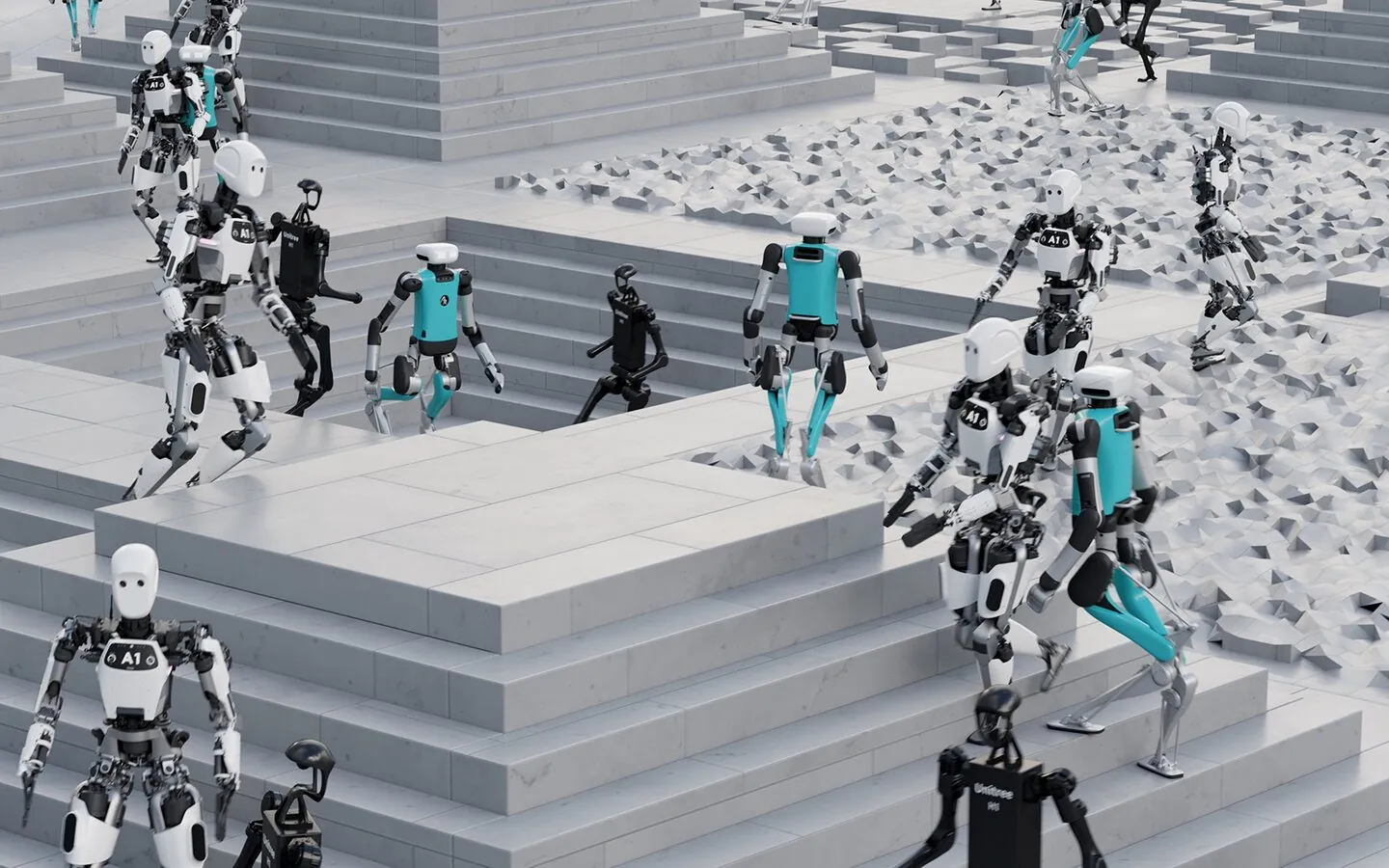
A physical robot is an expensive place to discover that a camera is mounted slightly wrong, a gripper cannot reach a shelf, or a planner breaks when the lights change. Simulation does not eliminate those failures, but it gives teams a repeatable place to find more of them before the hardware is waiting on the lab floor.
NVIDIA describes Isaac Sim as a scalable robotics simulation application and development framework for building, testing, and training robots. Its value is less about making a convincing demo than about turning a physical environment into something a team can reset, vary, instrument, and run again.
The scene becomes a test fixture
A simulated scene can hold the same kinds of objects and constraints that make a physical task difficult: a narrow approach, an occluded marker, a moving obstacle, or a surface that changes the robot’s grip. Once the scene is represented in software, a team can replay the task after a code change instead of relying on whoever has access to the robot that afternoon.
That repeatability changes the rhythm of development. Engineers can compare two planners against the same starting conditions, vary one sensor assumption at a time, and collect failures without risking a collision or consuming a day of setup. The simulation becomes a test fixture for the whole stack, not only a visual environment for a model.
Synthetic data is a shortcut to coverage
Vision systems need examples of the world they are expected to recognize. Capturing every lighting condition, camera angle, object pose, and background in a physical lab is slow and expensive. A simulation pipeline can generate labeled variations systematically, giving a model more coverage before a robot encounters the same edge case outside the digital scene.
The shortcut has a boundary. Synthetic data is only useful when the simulated sensors and environments are close enough to the physical problem. A model trained on perfect edges, clean depth readings, or frictionless objects may look excellent in the simulator and fail immediately in a warehouse. The most useful workflow treats simulation as a source of breadth, then uses real-world tests to correct its assumptions.
From model demo to development loop
The interesting shift is to make simulation part of the normal engineering loop. A team can build a scene, test a controller, generate data, inspect failures, and update the physical robot with a clearer idea of what remains uncertain. For ROS 2 teams, the simulation also needs to fit the same message and control interfaces used by the robot, so the boundary between virtual and physical work stays visible.
That makes Isaac Sim most useful when it is treated as an experiment system rather than a promise that reality has been solved. It can expose timing assumptions, provide repeatable regression tests, and make rare situations easier to study. The robot still has to prove itself in the world, but the world no longer has to be the first place the team asks every question.