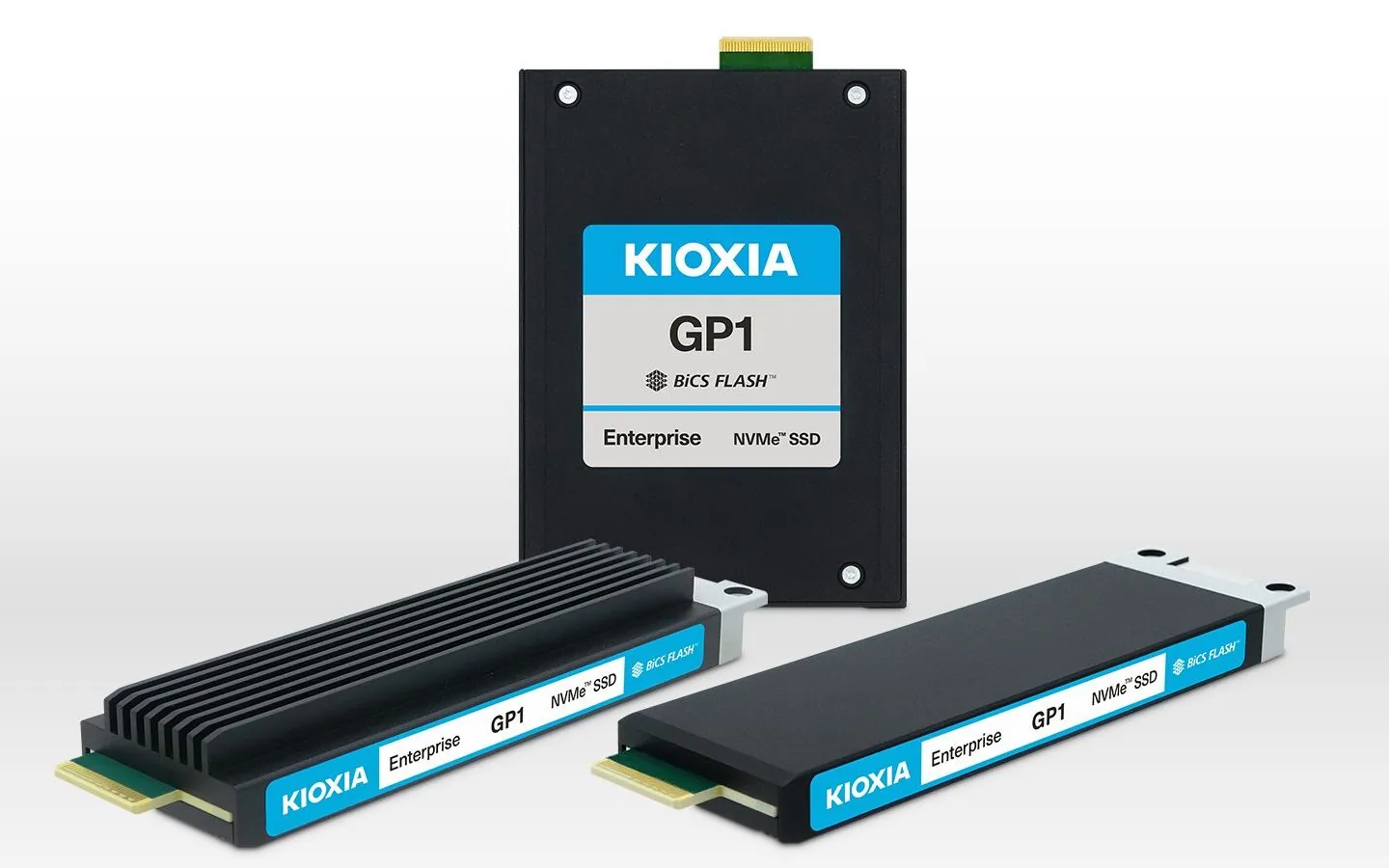
Kioxia announced the GP1 Series PCIe 6.0 NVMe SSD on August 3, claiming up to 10 million random read IOPS from its XL-FLASH generation 2 memory. The company calls the drive the first product in its GP Series of super high IOPS SSDs optimized for GPU direct access, and positions it as a flash-based memory extension tier for AI systems.
The announcement landed just before FMS: the Future of Memory and Storage, held August 4 to 6 in Santa Clara, where Kioxia’s GP Series took the Best of Show award in the Specialized Storage category. The award release calls the line the industry’s first super-high IOPS PCIe SSD optimized for GPU direct access as of March 16, 2026, and quotes FMS conference director George Mullins saying storage is becoming a critical enabler of next-generation AI system architectures.
The GP1 Series is built to the PCIe 6.0 and NVMe 2.2 specifications. Kioxia says the drives deliver up to 10 million random read IOPS at a 512-byte block size, use XL-FLASH generation 2 low-latency memory, and come in E3.S and E1.S 9.5 mm and 15 mm form factors, with cold-plate liquid cooling capability in the E3.S and E1.S 9.5 mm versions. Endurance is rated up to 50 drive writes per day. Unlike conventional triple-level cell NAND, XL-FLASH behaves as storage class memory, prioritizing ultra-low latency and fine-grained 512-byte access over raw capacity.
The design targets the memory wall in AI servers. High bandwidth memory is fast but far too expensive to scale indefinitely, and models are outgrowing the HBM attached to server GPUs, leaving those processors idle waiting for data. Kioxia’s drives enable GPU-initiated data movement, so systems can expand usable memory with flash instead of paying for more HBM, a performant middle ground between on-chip memory and conventional storage. The approach aligns with open-source initiatives such as Big Accelerator Memory and Nvidia’s Storage-Next framework, and it speaks to the same memory bandwidth bottleneck this site has covered before.
Kioxia says the architecture is designed to scale from today’s 10 million IOPS to future generations targeting up to 100 million IOPS. Neville Ichhaporia, senior vice president and general manager of the SSD business unit at Kioxia America, called the AI memory wall a critical challenge for the industry and said the GP1 enables a new AI memory topology, with a significantly lower cost per gigabyte than expanding in-node HBM or DRAM capacity. The drive builds on the GP Series technology Kioxia first detailed in March, and the company sees flash taking on a memory extension role rather than a traditional storage role.
The GP Series was first announced in March as an SSD family optimized for GPU-initiated AI workloads, and the GP1 is the first product to reach that line. Kioxia says evaluation samples will be available to select enterprise customers by the end of 2026, with final mass-production specifications still to be confirmed.
The near-term signal was FMS, where the drive picked up the award, and the next confirmed milestone is sample availability to select customers before the end of the year. Whether flash can genuinely stand in for added HBM in production AI servers is a question that evaluation samples, not launch slides, will answer.