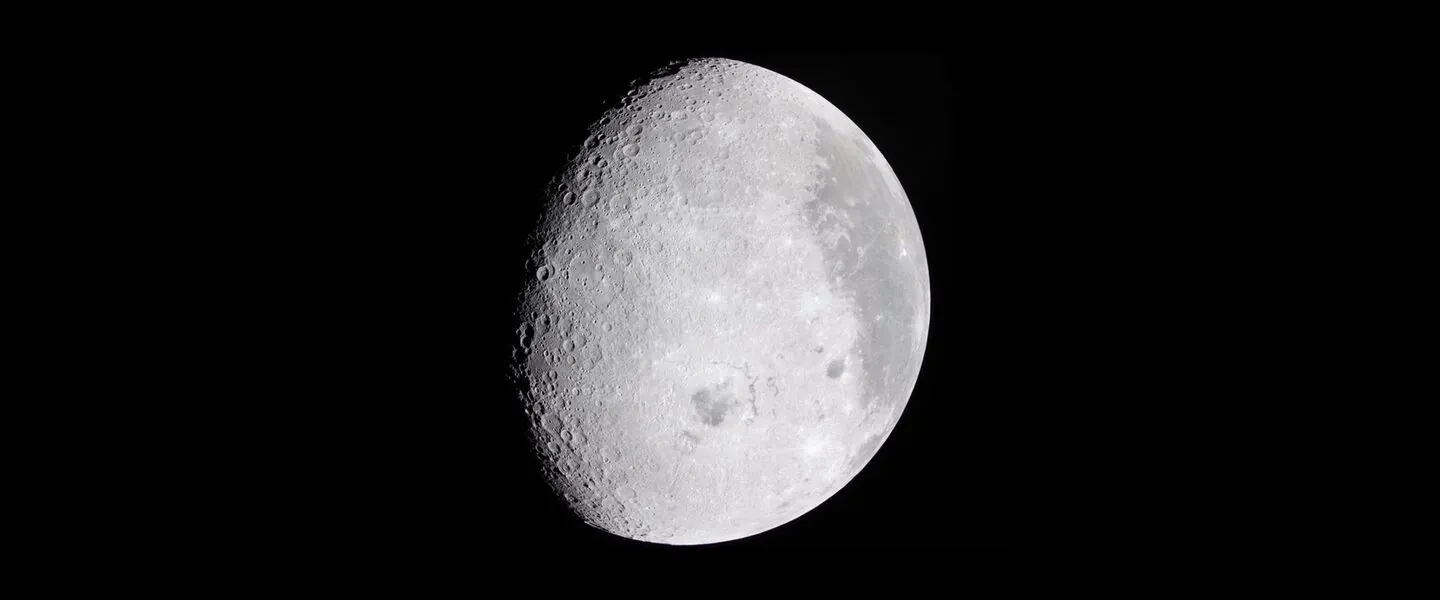
NASA and IBM have released the NASA-IBM Lunar Foundation Model, an open model built to help scientists read the Moon’s surface across decades of observations. The official IBM announcement says the release combines lunar data from different instruments and resolutions, turning a fragmented archive into a starting point for new scientific models.
The collaboration is aimed at three concrete problems: finding potential ice deposits, mapping craters, and studying volcanic features. NASA’s account of the project describes a model trained on high-resolution lunar imagery and terrain data, while the NASA Science report places the work inside the agency’s wider effort to apply foundation models to scientific data. This is a research tool, not an autonomous navigation system or proof that a landing site is safe.
One representation for many lunar instruments
IBM and NASA say their accompanying dataset brings together more than 30 spatially aligned layers from nine instruments across four missions. The sources include NASA’s Lunar Reconnaissance Orbiter and GRAIL missions, along with complementary observations from Japan’s SELENE/Kaguya mission. The point is not simply to put more pictures into a training set. Measurements made at different spatial scales and with different sensors can describe the same terrain in incompatible ways, which makes direct comparison and reuse difficult.
The model is based on a version of TerraMind, IBM’s multimodal Earth-observation model. In the IBM Research account, the team explains that the lunar model learns across modalities and resolutions so researchers can adapt one representation to several downstream tasks. That approach is closer to building a shared map of evidence than training one narrow detector for every new question.
The practical targets show why that matters. Permanently shadowed polar regions are difficult to observe, yet they may hold water ice that future missions could use for drinking water, oxygen, or propellant. The model combines topographic and temperature-related observations to identify areas with higher ice potential. IBM and NASA report that it reduced error for that task by up to 22 percent against a SwinV2-B ImageNet model, a result documented in the technical report linked from the release.
Crater detection offers a different test. At meter-scale resolution, the lunar model reached accuracy comparable to a task-specific Swin model. At a coarser context scale of roughly 100 meters per pixel, IBM and NASA report that it outperformed that comparison by nearly 19 percent while using half the training data. The release also reports a 3 percent improvement for mapping irregular mare patches, volcanic features that help researchers study the Moon’s thermal and geological history. These are research benchmarks from the project team, not guarantees for every image or downstream mission.
Open science still needs serious computing
The model’s value is tied to reuse. NASA and IBM are releasing the model and a machine-learning-ready lunar dataset so other researchers can adapt the work instead of rebuilding a multimodal pipeline from zero. Lightweight low-rank adapters were used for fine-tuning in the team’s description, leaving most base weights frozen. That can reduce the cost of adapting the model, but it does not remove the memory, storage, and data-engineering demands of working with large geospatial checkpoints.
That boundary is familiar from our explanation of specialized AI accelerators: a model can be open and reusable while still depending on serious compute for training or large-scale inference. It also echoes the distinction in our coverage of native-vision AI models, where input modality and evaluation setup matter as much as a model’s headline label.
The NASA-IBM release gives lunar researchers a common base for questions that are still being defined. Its next test will come from independent users who can validate the model on new regions, sensors, and scientific tasks, rather than from a single benchmark headline.