Tencent released and open-sourced Hy4 preview on August 28, positioning the model as a general-purpose system for long software projects, document-heavy office work, and scientific research. The company’s official announcement describes a 770-billion-parameter model with 49 billion active parameters and a context window exceeding one million tokens.
Those numbers describe a mixture-of-experts model, not a dense network that evaluates all 770 billion parameters for every token. Tencent’s official Hy4 preview model card identifies the release as an MoE system with 78 layers, 256 routed experts, and eight routed experts plus one shared expert active per token. That split is central to understanding both the model’s compute profile and the infrastructure challenge of serving its full weight set.
A 770B model aimed at long jobs
Tencent says Hy4 preview was trained with input from software engineers, game developers, finance analysts, security specialists, and other internal experts. The company is targeting work that extends beyond a short chat response: understanding and debugging long development tasks, turning scattered files into documents and spreadsheets, building playable game prototypes, and working through problems in areas such as molecular dynamics, condensed-matter physics, and mathematics.
That focus gives the release a different emphasis from a model launch built mainly around a single benchmark score. Tencent’s materials describe Hy4 as a productivity model that was co-designed with products including CodeBuddy and WorkBuddy. The practical question is whether the model can maintain a useful plan while it works through a large set of files, tool calls, or revisions. Our NPU, GPU, and CPU explainer covers the processor roles behind AI workloads, while our TPU guide explains another accelerator model. Hy4’s scale shifts attention toward memory capacity, interconnects, and distributed serving.
The release is available through several routes. Tencent says the open weights are published on Hugging Face, ModelScope, GitCode, and CNB, while API access is offered through Tencent Cloud TokenHub and OpenRouter. Hy4 preview is also available inside Tencent products including CodeBuddy, WorkBuddy, Yuanbao, and ima. WorkBuddy and CodeBuddy are scheduled to offer free access to Hy4 preview for two weeks after launch, and Tencent says free Hy3 access on those platforms has been extended through September 30.
The benchmark caveat matters
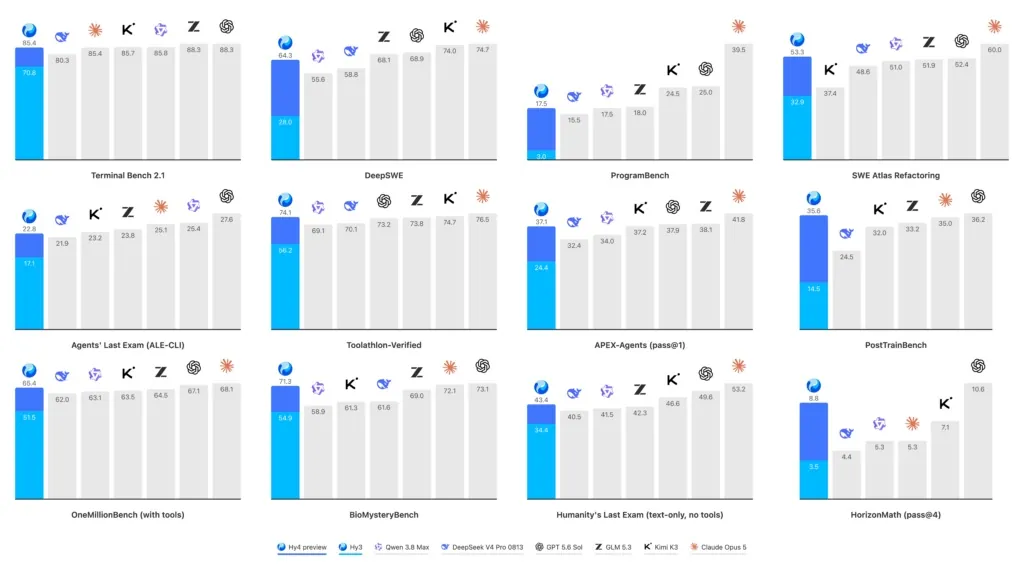
Tencent reports that 163 internal experts conducted a blind evaluation covering 203 engineering tasks. Hy4 preview received an average score of 2.99 out of 4.00, compared with 2.92 for GLM 5.3 and 2.94 for Kimi K3. The model card also reports Hy4 winning 46.8 percent of the GLM comparisons and 51.2 percent of the Kimi comparisons, excluding ties from those win figures.
That is useful evidence about Tencent’s own test, but it is not an independent benchmark. The task selection, judging process, and comparison models all come from the company’s evaluation. Readers should treat the result as an early signal rather than proof that Hy4 will outperform those systems across every coding or research workload.
The same caution applies to Tencent’s systems claims. The company says Hy4 helped automate parts of its own training and inference optimization work, and reports a 31.8 percent end-to-end throughput increase over a baseline after changes such as operator fusion and communication optimization. Those are vendor-reported results, not measurements Neon Control independently reproduced.
Hy4’s open license does not make it a lightweight local download. The model card lists the release under Apache 2.0 and provides FP8 weights, vLLM instructions, and SGLang instructions. Tencent’s example vLLM command uses eight-way tensor parallelism. That is a reference deployment configuration, not a stated minimum hardware requirement, but it makes the serving reality clear: a 770B-parameter model still calls for serious memory and networking even when only 49B parameters are active for each token.
The model is explicitly labeled a preview. Tencent lists longer-than-necessary reasoning and a tendency to over-verify work among its known issues, and says more Hy4 models are expected. That early status is important for readers following our analysis of how open-weight models make their hardware case. For developers, the important change is immediate access to a very large open model with a million-token context. For infrastructure teams, the more consequential test will be whether that context and reasoning capacity can be delivered at a practical cost.