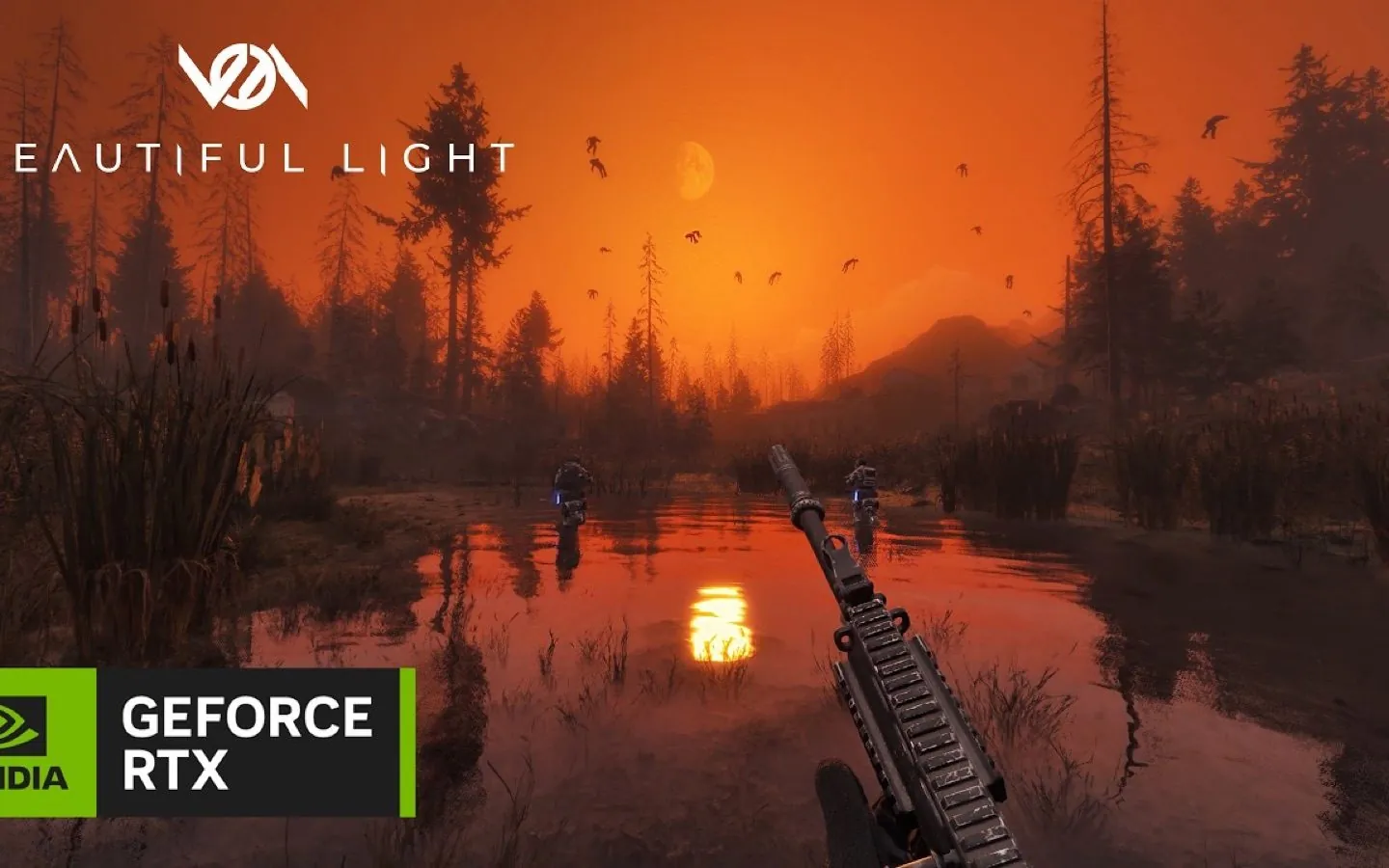
What is DLSS 4.5? It is Nvidia’s current suite of AI rendering technologies for GeForce RTX graphics cards, and its final piece went live today: DLSS 4.5 Ray Reconstruction is available now, adding a second-generation transformer model for ray-traced and path-traced games. The release landed on August 25, 2026, as Gamescom 2026 begins, and it covers every GeForce RTX GPU, from the RTX 20 series through the RTX 50 series.
The short answer for anyone catching up: Ray Reconstruction is the AI denoiser behind ray tracing, and version 4.5 replaces the first-generation transformer with a model Nvidia says produces sharper, more stable images at a similar performance cost. The company detailed the rollout in its official Gamescom briefing, and the GeForce team confirmed it on X alongside a new 4K reveal video for the extraction shooter Beautiful Light.
NVIDIA announced the update on X.
What the second-generation model changes
Ray Reconstruction first shipped with DLSS 3.5 in 2023 as a neural replacement for hand-tuned denoisers: instead of cleaning noisy ray-traced frames with fixed heuristics, an AI network trained on Nvidia supercomputers reconstructs pixels where rays were not sampled, unifying denoising and Super Resolution in a single model. Nvidia announced this edition at Computex on May 31 with an August release window that today’s update fulfills.
The release notes quantify the upgrade: the new denoiser delivers 35 percent more compute capability and processes 20 percent more parameters than the model it replaces, while maintaining similar performance. Beyond raw scale, the model carries deeper spatial awareness of each scene, leans harder on engine pixel sampling and motion data, and trained on a larger dataset, which Nvidia credits for improved lighting accuracy, better temporal stability, and clearer motion. Developers also get finer control over temporal accumulation for per-game tuning.
How to turn it on, and where you will see it
The model arrives through the NVIDIA app rather than game patches. Nvidia’s instructions: install GeForce Game Ready Driver 580.88 WHQL or newer, opt into Early Access releases under Settings, then open the Graphics section, pick a supported title or Global Settings, scroll to Driver Settings, open DLSS Override – Model Presets, choose Custom, and set Ray Reconstruction to Recommended or Preset F. An official, non-early-access release follows in September.
Thirty games accept the override at publication, including Cyberpunk 2077, Alan Wake 2, Indiana Jones and the Great Circle, DOOM: The Dark Ages, and Marvel’s Spider-Man 2. Nvidia’s comparison footage highlights cleaner snow particles in Indiana Jones, tighter laser lighting in PRAGMATA, and a more stable CRT static effect in Alan Wake 2. Independent numbers remain early but line up with the efficiency claim: TechPowerUp’s testing found frame rates within a few percent of the previous model, and VRAM growth of at most 63 MB across its tested games.
The rest of the suite has been rolling out since its CES debut on January 6: a second-generation Super Resolution transformer built on five times the compute of the original model, Dynamic Multi Frame Generation, and a 6X Multi Frame Generation mode for RTX 50 Series cards. Ray Reconstruction completes the set. Creators are included too, with Blender 5.3 integrating the model as a Cycles denoiser this fall.
For RTX owners the calculus is simple: the upgrade costs nothing, needs no new hardware, and applies globally through the app. Upcoming titles extend the list, with 007 First Light gaining path tracing and Ray Reconstruction on September 15, and Control Resonant launching with the full DLSS 4.5 suite while a bundle pairs it with select GeForce RTX hardware. Readers shopping in the other direction can see how entry-level silicon compares in our Arc B580 vs RTX 5050 vs RX 9050 comparison or our running best budget GPU picks.